


 SIGN UP FOR OUR
 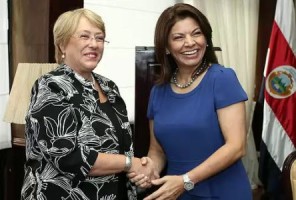 Chile, one of the most developed nations in Latin America, has a new President-elect. Former President Michelle Bachelet will once again lead the South American nation after a victory over her oponent Evelyn Matthei, also a female presidential candidate. In Costa Rica, President Laura Chinchilla will not be succeeded by a woman next year; however, she has set an important precedent for women in high-level political positions.
For all the talk about Latin America and the Caribbean being the last strongholds of machismo, the political leadership landscape features a considerable amount of estrogen. A recent article by Simon Romero in the New York Times provides a succinct summation of this political trend:
Eight of the estimated 29 women in the world who have been elected as presidents of their countries since the 1970s have done so in Latin America and the Caribbean, long considered a bastion of machismo, with half of them ascending since 2006. Up and down the Americas, with the notable exception of the United States, women are soaring into the highest political realms.
In South America, we have President-elect Bachelet of Chile, President Dilma Rousseff of Brazil and President Cristina Fernández de Kirchner in Argentina, who is on her second term. In the Caribbean we have Prime Minister Portia Simpson-Miller of Jamaica and Prime Minister Kamla Persad-Bissessar of Trinidad and Tobago.
Although the administration of President Chinchilla has been marred by historically-low approval ratings, a dubious cabinet and the embarrassing La Trocha road to nowhere along the border with Nicaragua, few can question what she has been able to accomplished with regard to female empowerment in Costa Rica. Ever since she took a leadership role in the powerful National Liberation Party (Spanish initials: PLN) in 2009, she has made her position clear in terms of what it means for her to be the first woman to lead Costa Rica:
“Across the country, in each school, our daughters know that change has come, that they no longer have restrictions with regard to decision-making in Costa Rica.”
This last Tuesday, President Chinchilla once again spoke about female achievement and empowerment in Costa Rica at the draw of the 2014 FIFA Under-17 Women’s World Cup:
“Women, in football as well as in different aspects of modern life… we are no longer mere spectators. We are protagonists, or else we are fighting for the right to be. For this reason I celebrate these competitions in a country where we, as women, have torn down many walls.”
In Costa Rica, women have been thoroughly integrated into the political process. When voters head to the polls next year to elect their new leaders, they will see that at least 40 percent of the legislative candidates on the ballots are women. This is part of a 1999 resolution by the Electoral Tribunal, which guarantees female political participation by forcing parties to nominate women to 40 percent of their representative roles. If a political party does not have a certain minimum of women as candidates, the party cannot be certified.
Costa Rica is not the only Latin American nation that features this forced political quota. Argentina, Bolivia and Ecuador have similar measures.



