


 SIGN UP FOR OUR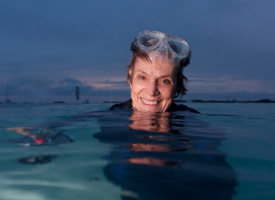
Oceanographer Sylvia Earle
One of the most recognized names in oceanography and marine life conservation is coming to Costa Rica as part of Mission Blue, a significant expedition that serves as an ocean community’s effort to elevate public awareness about critical ocean issues and inspiring support for organizations, projects and scientific expeditions that make a positive difference for the ocean.
Oceanographer Sylvia Earle has spent a good part of her life underwater. She is a National Geographic Society Explorer in Residence, and is often addressed as Her Deepness by publications such as the New York Times. She has led more than 100 expeditions and logged more than 7000 hours underwater. She is leading Mission Blue into Guanacaste as part of the Central American Dome Hope Spot Expedition, which is being supported by Costa Rican ocean conservation non-profit MarViva.
As previously reported in length by the Costa Rica Star, the Thermal Convection Dome is the richest underwater biomass in the world. The Pacific coast of Costa Rica is teeming with marine life, and the dome is a major reason for this:
[the dome] represents the highest concentration of chlorophyll in the world, up to 60 milligrams per cubic centimeter of sea water. This means that a lot of phytoplankton -unicellular algae that eventually photosynthesizes into plankton- is available for the pleasure of a number of migratory marine species, including crabs, dolphins, marlin, tuna, turtles, whales and more. These species swim and crawl across thousands of kilometers to feast and reproduce off our coast.
According to Sylvia Earle and Mission Blue, the Costa Rica Dome needs to be recognized as:
a site of global importance for one of the most iconic marine creatures, the critically endangered leatherback turtle. The Dome provides an important migration route and foraging area for adult turtles, as well as critical habitat for hatchlings leaving their nesting beaches in Central America. Leatherback populations in the Eastern Pacific were reduced by 90% over the past two decades, mainly due to unsustainable egg harvesting and fisheries by-catch.
On Day Two of the expedition, the Mission Blue and MarViva crews were in Playa Grande, Guanacaste:
Tourists from all over the world come to the beaches of Playa Grande in Costa Rica to have the awe-inspiring experience of watching giant leatherback turtles lay their eggs after returning to the coast from waters of the Central American Dome Hope Spot offshore.
In addition to the undeniable value of the leatherback within the marine ecosystem, this critically endangered species holds promise as a focal point for sustainable development in the coastal communities surrounding their nesting beaches.
Mission Blue documentaries highlighting Costa Rica are forthcoming, and they will be followed in 2015 by the second phase of the project, which will focus on blue whales.



