


 SIGN UP FOR OUR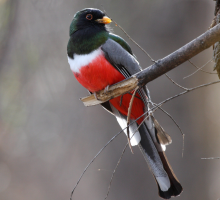
Trogon elegans bird in Guanacaste Costa Rica
One of the most endearing and emblematic birds of Guanacaste is the Trogon elegans, also known as bobo, momoto, cejiceleste, and others. The Trogon elegans is among the most attractive species of the Trogonidae family, which can be found from the Southwestern United States to the northern region of Costa Rica. This magnificent bird has been the focus of scientific interest, and a recent research study reveals some interesting behavior.
The plumage of the male Trogons elegans is distinctive and colorful. These 30 cm (12 in) long birds have yellow bills and a fiery-red undertail with white stripes across their breasts. The male trogons in Guanacaste tend to be green or dark green from its head down to its upper breast, back and belly. Its face and throat are as black as night, and red-orange lower breast and belly.
Male trogons tend to attract females by a bold display of their plumage and a certain tail-raising technique, which is the focus of a recent study published in Behavioral Ecology. Pierre-Paul Bitton and Stéphanie M. Doucet of the University of Windsor traveled to Costa Rica to study the Trogons elegans in its habitat of Guanacaste.
Most avian behaviors such as raising the tail serve a specific purpose. A bird may have a call or song for a potential mate and a different one for warning predators that they are ready to stand their ground or fly away. The trogons, however, present a multifunctional visual display:
In this study, combining observational and experimental approaches, we present evidence that a tail-raising display performed by the elegant trogon (Trogon elegans) is used in multiple contexts and is directed at conspecifics and heterospecifics. We observed tail-raising displays toward conspecifics in both intersexual and intrasexual contexts, as well as toward heterospecifics.
Displays performed toward heterospecifics were directed at humans, monkeys, or birds of prey, all of which could have been perceived as potential predators. We experimentally tested the possible functions of tail-raising behavior in the presence of a predator by presenting elegant trogons with models of a natural predator and a nonthreatening control. Our results suggest that tail raising in trogons is a multifunctional visual display that may function as an intersexual and intrasexual conspecific signal as well as a pursuit-deterrent signal directed at predators.
The Guanacaste Conservation Area is also conducting research on the Trogonidae family in their parks and wildlife refuges; specifically on their nesting and birthing behaviors (they reproduce between three and four nestlings) as well as their favorite diet (butterfly larvae and a range of insects). Results from this study are forthcoming.



