


 SIGN UP FOR OUR
 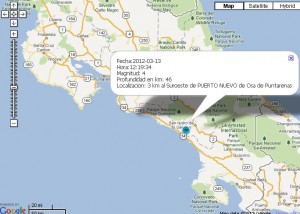 The styluses of the seismometers at the research departments of our national universities were busy on Tuesday, March 13th with reports of an earthquake that was slightly felt during lunchtime.
The epicenter of the seismic event has not yet been pinpointed. The initial reports from the Seismic and Volcanology Observatory (OVSICORI in Spanish) indicate that the epicenter was three kilometers southwest of Puerto Nuevo in the Osa canton of the Puntarenas province. The epicenter later changed to 9 kilometers southeast of the beach at Dominical.
The National Seismologic Network (RSN in Spanish) reported the same quake with an epicenter located a kilometer northeast of Bahia Ballena. There were slight differences in magnitude readings and depth. The OVSICORI reported a magnitude 4.1 on the Richter scale at a depth of 51 kilometers. The RSN measured the strength of the quake as 4, and a depth of 45.6 km.
The OVSICORI is based in the National University; the RSN is in the University of Costa Rica. A stronger 4.8 earthquake was reported a little over a week ago, with an epicenter located 75 kilometers southwest of Drake Bay.
The quake was originated by tectonic subduction and was reported to have been slightly felt in the Central Valley.
Using Social Media in Seismic Research
News of the quake were announced via Facebook and Twitter by both OVSICORI and the RSN. Seismic research centers have found a powerful ally in social media and mobile devices. The 2011 Virginia earthquake in the Eastern Seaboard of the United States has served as a template for the use of social media in emergency management and seismic research. During the Virginia earthquake, Twitter members far from the epicenter learned about the quake seconds before the seismic wave traveled over hundreds of miles -a veritable early warning system.
Aside from publishing information about seismic events on online social networks, the RSN is interested in collecting information about perceived earthquakes. Insight into the intensity of a seismic event can be gleaned from social media reactions. For example, when the RSN publishes information about slight earthquakes on its Facebook wall, the comments of “no lo senti” (I didn’t feel it) are common.
The RSN invites anyone in Costa Rica with a Facebook account to post earthquake reports to their profile with the following reporting factors:
- Approximate time of the tremor or quake.
- Geographical location where the quake was felt.
- Some kind of reference of how you perceived the quake/tremor (i.e.: strong, moderate, weak). Damage can be reported on Facebook to give researchers important data they can use.



