


 SIGN UP FOR OUR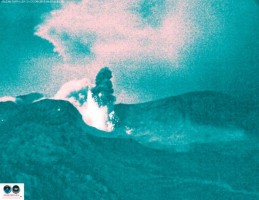
Night vision photograph of the Turrialba eruption. Source: OVSICORI
Do you love the smell of sulfur in the morning? It smells like… geology. This morning, residents and tourists in various neighborhoods of the Greater San Jose Metropolitan Area (Spanish initials: GAM) in Costa Rica awoke to an acrid and pungent aroma, which is a common occurrence for the farming communities that lie on the skirts of the Turrialba volcano in the province of Cartago.
The sulfurous smell was the byproduct of a potent, early morning eruption of the Turrialba. According to geologists from the Observatory of Seismology and Volcanology of Costa Rica (Spanish acronym: OVSICORI), the eruption took place at 2:05 am, and the column of volcanic matter expelled reached 2 kilometers in the air.
A night vision camera installed at the crater of the Turrialba showed images of incandescent rocks along with volcanic ash and noxious gases, which were ejected with great force. This volcanic material was mostly deposited on the western sector of the crater, except for a gaseous ash cloud that was whisked away by strong air currents.
The “rotten egg” smell of sulfuric acid occurs when sulfur dioxide, which is carried by volcanic ash, combines with a mixture of hydrogen and oxygen molecules (water). In this case, mountain dew (not the soft drink) could be to blame for the activating the sulfur smell as it comes in contact with ash from the Turrialba volcano.
The GAM communities that reported the smell of sulfur in the morning included:
Ash was deposited as far as the canton of Grecia in the province of Alajuela. As of 10:00 am, earth scientists from the OVSICORI and the National Seismology Network of the University of Costa Rica were busy trying to determine if the eruption of a nature similar to recent activity, which has not been magmatic. As previously reported by The Costa Rica Star, the Turrialba volcano is an active and unpredictable colossus, and thus tourists should refrain from trying to enter the national park.



