


 SIGN UP FOR OUR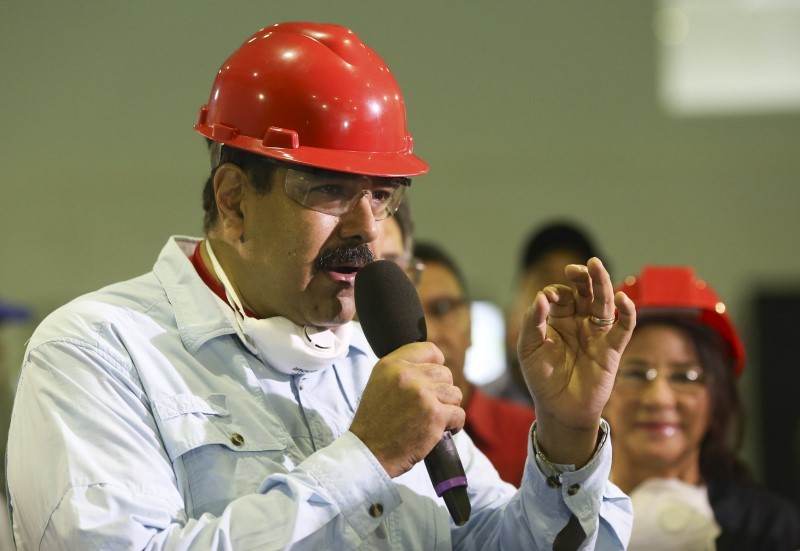
Venezuela’s President Nicolas Maduro (L) talks during the opening ceremony of a plant of PVC tubes in the state of Carabobo, in this handout picture provided by Miraflores Palace on February 11, 2016. REUTERS/Miraflores Palace/Handout via Reuters
CARACAS – Venezuela’s Supreme Court approved President Nicolas Maduro’s “economic emergency” decree on Thursday, setting up a showdown after the Venezuelan Congress rejected the measure last month.
Maduro’s decree includes wider executive powers to control the budget, companies and the currency amid a severe economic crisis in the OPEC nation.
The new opposition-led National Assembly shot the measure down in late January, saying it offered no real solutions to the worsening recession, shortages, and inflation.
However, in a decision published on its website, Venezuela’s top court granted leftist Maduro those executive powers, foreshadowing an institutional showdown.
The Caracas-based court ruled that Maduro’s decree granting himself expanded authority over the economy for 60 days is legitimate. The court said opposition lawmakers did not follow the correct procedures for opposing the measure.
“Now the economic emergency decree has been activated,” Maduro rejoiced on state television. “So in the next few days I will activate a series of measures that I had been working on. This really helps our work.”
Maduro’s decree grants him the ability to take over the resources of private companies, limit access to currency, and “other social, economic, or political measures deemed fitting.”
Venezuela’s opposition accused what it described as a subservient judiciary of undermining democracy.
“The Supreme Court cannot usurp the powers of the legislature,” Juan Guaido, an opposition lawmaker from Vargas, said on Twitter.
The opposition has vowed to find a legal way to remove Maduro, by resignation or referendum, by mid-2016.
An economy in shambles
Venezuela’s Central Bank, which has been lambasted by critics of President Nicolas Maduro’s government for hiding statistics since the end of 2014, said in January that the South American OPEC nation’s economy shrank 4.5 percent in the first nine months last year.
Inflation soared in that period to an annual rate of 141.5 percent, the world’s worst.
Venezuela’s oil-dependent economy is forecast to perform abysmally again in 2016. Maduro lost control of the National Assembly in a December election due to voter ire over the crisis.
“We are confronting a true storm,” Maduro said during his state-of-the-nation address to Congress. “This is not Maduro’s storm, as some believe, it is a situation throughout the country that affects every Venezuelan family.”
Maduro, a former bus driver and foreign minister who was elected to replace Hugo Chavez in 2013, has stuck to his mentor’s policies of strict currency and price controls.
With massive shopping lines in Venezuela and widespread shortages of basics from milk to medicines, the government faces mounting pressure to change what critics call a failed model.
Primary reporting by Reuters. Additional reporting and editing by VOA and The Costa Rica Star.



