


 SIGN UP FOR OUR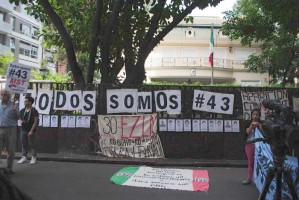
Wikimedia Commons
Mexico City, Apr 2 (EFE).– Six experts have concluded that at least 17 people were incinerated at a garbage dump in the southern Mexican town of Cocula and said more tests would be carried out to determine whether the bodies of all 43 students who went missing in 2014 could have been burned to ashes there, the latest development in a case that has garnered international attention.
Ricardo Torres, spokesman for the group that conducted a new analysis at the site, said Friday there was “sufficient, even physically observable, evidence to affirm that there was a controlled, large-scale fire event” at the municipal dump in Cocula, located in the southern state of Guerrero.
He added that the skeletal remains that were collected “indicate that at least 17 adult human beings were incinerated at that place.”
In a statement to the press, Torres said the group of fire experts would only be able to establish whether a mass burning of 43 bodies occurred, as suspects detained in the case have told investigators, by carrying out large-scale tests in the coming weeks.
The group is made up of six fire experts from several countries, including Peruvian Jose Torero, who had conducted an earlier analysis at the request of the Interdisciplinary Group of Independent Experts, or GIEI, which had been designated by the Inter-American Commission on Human Rights Commission, or IACHR, to study the case.
In that prior analysis, Torero had concluded that it was not possible for 43 bodies to have been incinerated at the dump on Sept. 27, 2014, the day after the students disappeared, contradicting the “historical truth” presented by the government in early 2015.
Indeed, he determined last year that there had not been enough fire to burn even one body, according to the GIEI’s report.
On the night of Sept. 26, 2014, police in Iguala, a city in Guerrero, attacked students from the Ayotzinapa Normal School, a nearby teachers training institution, after the aspiring educators had commandeered buses that they planned to use to travel to Mexico City for a protest.
Six people – including three students – were killed and 43 other students were abducted that night.
Federal authorities say the incident was the work of corrupt municipal cops acting on the orders of Iguala’s crooked mayor.
The cops handed over the students to Guerreros Unidos drug cartel gunmen, who killed the young people and burned their bodies at the Cocula garbage dump, according to the official story.
But the parents of the missing students refuse to accept that account, which the GIEI also rejected in its report issued on Sept. 6, 2015.
Besides ruling out the incineration hypothesis, those independent experts also corroborated reports indicating that state and federal security forces had been monitoring the students since they left Ayotzinapa for Iguala and at the very least knew that they had come under armed attack yet did not intervene.
A separate study by the Argentine Forensic Anthropology Team, or EAAF, which participated in the investigation at the request of the victims’ parents, said in February that there was a discrepancy “between the scientific and testimonial evidence” and also ruled out the body-burning theory.
The latest international analysis was carried out in compliance with agreements reached between Mexico’s Attorney General’s Office and the GIEI on Oct. 20, 2015, during a public hearing on the case at the IACHR’s headquarters in Washington and was expected to have resolved any differences.
But the conclusions revealed Friday, which back the much-maligned original version offered by the AG’s office, and the stated need for further tests have prolonged the uncertainty surrounding what happened to the students.
In statements to EFE, the attorney for the parents of the 43 trainee teachers, Vidulfo Rosales, said it would be “irresponsible” to immediately comment on an “extremely delicate matter” without thoroughly reviewing the new expert opinion.
He said he expected the parents would be able to comment on Monday once they had studied the report.
Rosales said it was regrettable that the experts publicly announced the results of the new study, a matter of “great impact” for the victims’ parents, before informing the families.
In so doing, the government had broken its promise regarding the communication of sensitive information about the case, he added.
The GIEI is going to “study the report” because there are things that “don’t exactly fit with what they have,” the attorney said.
Shortly afterward, the GIEI, whose mandate to investigate the case in Mexico expires in April, issued a statement accusing the federal AG’s office of violating agreements concerning the release of new findings.
It said it would reconsider its work in light of the actions by the AG’s office, while also vowing to continue to do what is “necessary to make progress in clearing up the case.” EFE



