


 SIGN UP FOR OUR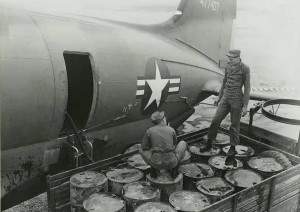
U.S. soldiers load DDT into aircraft for malaria control spraying in Korea, 1951.
The University of Costa Rica (UCR) recently screened two documentaries that deal with significant environmental issues in our country. One film focuses on the impact of pesticides and other agrochemical products on the environment and subsequently on the health of human communities, while the other documentary looks at the legislative debate surrounding hydrocarbon gas exploration in Costa Rica.
Silent Snow
The Institute of Social Investigations (IIS-UCR) screened Silent Snow, The Invisible Poisoning of the World in early April. It is a story told by Pipaluk Knudsen-Ostermann, a young woman who lives in Greenland and notices that her community is suffering from poisoning by dichlorodiphenyltrichloroethane (DDT). This powerful insecticide was banned in the United States in the early 1970s, but it is still being used elsewhere around the world.
In Silent Snow, the poisoning in Pipaluk’s town comes from the earth, the aquifer, the snow, the animals, and ultimately humans. Pipaluk then travels to Africa and India, where DDT has been used to control pests and vector-borne disease like malaria. Aside from DDT, Silent Snow looks at other toxic products used in agriculture that eventually cause irreversible damage to Nature and all her species.
Pipaluk also travels to Costa Rica, where she finds evidence of insecticide use but finds hope in the Talamanca region where the Bribri people use herbs to control pests in an eco-friendly manner.
The screening was facilitated by Jorine Musier, a member of the Netherlands diplomatic corps in Costa Rica. Silent Snow is directed by Jan van den Berg, a Dutch filmmaker. At the screening, Musier indicated that:
“We understand that in Costa Rica malaria was eradicated mostly by education and awareness campaigns conducted by the public health system. We visited the Talamanca region, which provided the director with a positive reality [that contrasted with the other terrible real-life stories on the film].”
Las Trampas del Gas
Academic staff and researchers from UCR also screened Pablo Ortega’s Las Trampas del Gas (Gas Traps), a documentary video that is available from YouTube.
According to digital news daily El Pais, the film reveals a dichotomy practiced by the current administration with regard to environmental protection and existing legislation that could provide for the exploration for, and extraction of, hydrocarbon gas in our country.
An environmental researcher from UCR commented on the film:
“We are looking at a law that is outdated and obsolete. It was approved back in 1994, towards the end of the Rafael Angel Calderon administration, and it does not conform to the new environmental protection legislation nor the jurisprudence of Sala Cuarta (Constitutional Hall).”
According to El Pais, Ortega’s film could not get an opinion from Rene Castro, the current Minister of the Environment, on the matter. The director states that the film is not opposed to the use of hydrocarbon gas as an energy source; but, he is concerned that the current law would allow the unregulated exploration by international enterprises instead of by RECOPE or ICE.



