


 SIGN UP FOR OUR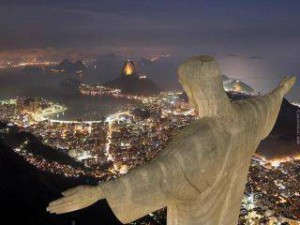
The Magnificent City of Rio de Janeiro at Night
Brazil, the economic colossus of Latin America, is having a hard time getting ready to host the 2014 FIFA World Cup and the 2016 Summer Olympics. The construction and improvement of infrastructure needed to accommodate thousands of visitors to the world’s premier sporting events is constantly running into problems.
The country with the largest Portuguese-speaking population in the world has been hailed both as a model for economic success and inequality. Brazil’s vast natural resources and workforce are salient points of its recovery from the crippling military dictatorship that cultivated injustice and paralyzed development in the 1960s and 1970s. It was during that period that the infamous Cidade de Deus (City of God) was formed.
Ordem e Progresso
Brazil’s motto, proudly emblazoned on its colorful flag, is very illustrative of the unbridled economic success experienced by the South American nation in the last few years. This was very evident in the administration of former President Luiz Inacio Lula da Silva, who pushed economic and social reforms that advanced his beloved country and citizenry. A similar model of national order and progress is being followed by President Dilma Rousseff, the first woman elected to lead Brazil and President Lula’s former Chief of Staff.
When Brazil was selected to host the 2014 FIFA World Cup and the Games of the XXXI Olympiad, Brazilians all over the world were ecstatic as they considered both events to be just recognition by the international community of their country’s progress over the last few years, and further motivation to show the world why they are the “B” of the BRIC nations (the others are Russia, India and China -all paragons of new economic development).
Once preparations for the events began, however, Brazilians realized that they can’t rest on their laurels just yet.
Land Disputes
Golf used to be an Olympic event, at least until the early 20th century. Rio de Janeiro now has the distinction of hosting the first Olympic rounds of golf in over 100 years, but selecting the land to build the course and links has been troublesome thus far. Brazil’s Higher Court of Justice will review a dispute between Italian entrepreneur Pasquale Mauro and the organizations planning the World Cup and the Olympics.
The problems center on Barra de Tijuca, an upscale neighborhood in Rio de Janeiro that drastically contrasts against the favelas (slums) in the City of God. If the legal matter is not settled soon, another site would have to be selected for the course, and its designers would have to hurry since the Olympic Committee requires completion by 2015.
Slum Dwellers and Massive Worker Strikes
In Vila Autodromo, a favela with 4,000 residents that is a fraction of the size of Cidade de Deus, homeowners are rejecting government proposals to evict them from their properties and relocate them, according to the New York Times. These residents are former squatters, and just like in Costa Rica, they can establish certain lawful rights over the lands they invade under some circumstances.
In the past, Vila Autodromo’s residents would have been removed by force, like the military dictatorship of Brazil used to do. These days, however, the democratic rule in Brazil -which has enabled the impressive economic recovery- is protecting the social interests of the slum dwellers. Until the matter at Vila Autodromo can be resolved, Brazil has no place to build its Olympic Park and house the athletes.
The demands of unionized construction workers building athletic venues for the World Cup and Olympics are also getting in the way of progress. More than 25,000 workers and members of labor unions are ready to go on strike in a moment’s notice, and they have already done so at different sites.
Archeological Findings
Construction laborers working on improvements to the Arco Metropolitano do Rio de Janeiro, a road that crosses the magnificent city, are unearthing an archeological gold rush, according to a report by the Agence France-Presse (AFP).
A team of 40 archeologists are scouring the road construction area around the Arco, and they are finding plenty of historical treasure. Since the project started in 2008, almost 60 sites with relics of about 6,000 years ago have been excavated. The new digs are producing artifacts and sites full of rich historical heritage from Brazil’s Portuguese colonial period and also from the indigenous Guarani people, who predate the Portuguese by several centuries.
While archeologists are busy unearthing and researching the findings by the construction crews, project engineers are left scratching their heads as to when they will be able to finish. The Arco highway will be crucial in providing relief to the chaotic traffic conditions expected for the World Cup and the Olympics.



