


 SIGN UP FOR OUR
On April 3, a delegation from the Russian Federation’s aerial landing troops arrived in Managua, Nicaragua to plan future joint military exercises with the country’s government, said the digital Russia Beyond the Headlines (RBTH). The end date for the maneuvers is unknown, as the military says they need to study the situation.
Experts say that the decision to hold military exercises in Nicaragua is to re-establish relations with Latin American countries and strengthen Russian influence near the United States.
“In the late 1970s, military support from the USSR led the Sandinista National Liberation Front rise to power. At that time our objective was to obtain points of political and military pressure near the U.S., in addition to Cuba,” said military analyst for Izvestia, Alexei Ramm.
According to Ramm, Nicaragua was one of the most hotly disputed Latin American countries between Moscow and Washington. Moscow sent military weapons and advisers to the Sandinista National Liberation Front, while Washington and the Ronald Reagan administration supplied anti-Sandinista radical opposition, called the “contras.” In the end, Nicaragua remained within the sphere of influence of the USSR, said RBTH.
However, after decades of decreased military contacts between the two countries, Moscow is trying to make up for lost time, said the news report.
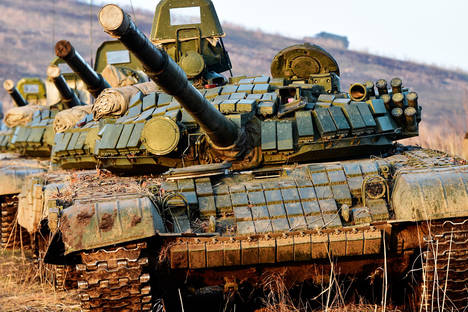
“The maneuvers are carried out to expand the collaboration and promote our tactics in the region. In particular, we are interested in selling T-55 and T-72 tanks to Nicaragua. We’ll see how exercises work in this regard,” added Ramm.
These exercise are designed to test an exercise in which 100 soldiers land and enter combat in 10 different vehicles to “destroy the positions of possible terrorists in the country,” explained the report in RBTH.
“These joint exercises with other countries are rarely held. For us it is mainly an opportunity to promote the technique that we would like to sell in the region. In addition to Nicaragua, we have only organized similar maneuvers in Egypt and India,” concluded Ramm.



