


 SIGN UP FOR OUR
 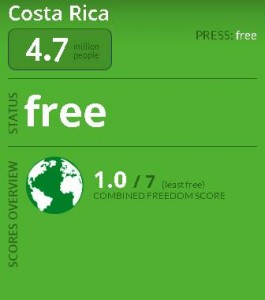 Freedom House, a non-profit organization that conducts research and advocacy in matters of democracy, freedom and human rights, today announced its annual Freedom of the Press 2012 reports. According to Freedom House, Costa Rica and Uruguay are the only two countries in Latin America where members of the press enjoy true freedom to carry on their mission to report the news and inform the public.
The Freedom of the Press 2012 report looked at 36 countries and territories in the Americas, where 937 million people make their lives. By Freedom House estimates, the press in the Americas is 71 percent free. Latin America is a predominantly Spanish and Portuguese speaking region of the world, and in recent years members of the press and journalist community in this region have been assailed by interference from corporate, criminal, governmental, and political elements. There are 16 Latin American nations where Freedom House has found problems that prevent freedom of the press.
Tico journalists should count their blessings, according to the Freedom House report. Here are some excerpts from the report, which looks at the state of press freedom in 2011:
Journalists are not often victims of physical threats or violence in Costa Rica. There were no reports of attacks or harassment against journalists in the year. Challenges to a free media environment tend to stem from the courts, though the majority of recent legal decisions have represented gains for press freedom.
Costa Rica has a vibrant media scene, with numerous public and privately owned newspapers, television outlets, and radio stations. Private media ownership is highly concentrated, however, and tends to be conservative. The press is relatively free to cover sensitive political and social issues, and to openly criticize the government. Radio is the most popular outlet for news dissemination. There are nine major newspapers, and cable television is also widely available. New online news organizations have become very popular. The internet served as an additional source of unrestricted information and was accessed by more than 36.5 percent of the population in 2010.
A similar situation was observed in Uruguay, a country where democracy, education and scientific endeavor have been elevating the quality of life in that South American nation over the last few years:
The media [outlets] in Uruguay are vibrant, and journalists generally do not practice self-censorship. However, reports about the 1972–85 military dictatorship still sometimes prompt reprisals. Political polarization in the country is muted by regional standards. Although President José Mugica, a former leftist guerrilla, has criticized the press on certain occasions, he has taken no systematic steps to favor left-leaning outlets or rein in criticism from more conservative news sources. Journalists generally can cover the news freely. There were no reported cases of extralegal harassment or attacks against journalists during 2010.
The press is privately owned and boasts more than 100 daily and weekly newspapers. The broadcast sector is mostly private, with the exceptions of the state-owned television station and radio outlet. There were no government restrictions on the internet, which was accessed by 43 percent of the population during the year.
Chile, a South American nation that often scores high in terms of press freedom, was sadly relegated last year to the bloc of 16 Latin American countries where the press is partially free. Journalists in Chile who covered the wave of protests and demonstrations last year over educational and environmental concerns sometimes found themselves blocked or threatened.
The press corps in Cuba, Honduras, Mexico, and Venezuela did not enjoy too much freedom in 2011.



