


 SIGN UP FOR OUR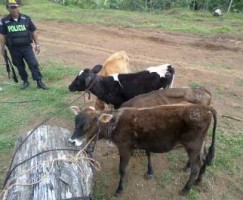
Source: Fuerza Publica
Fuerza Publica officers assigned to the Northern Zone in Upala, working in conjunction with the Office of Judicial Investigations (OIJ), recently announced the recovery of four cows found in farm that served as a hideaway for rustlers. Officers cited the support from the border security police and members of the community as they conducted door-to-door (or barn-to-barn) interviews to find the gang of cattle thieves in El Progreso de Upala.
Meanwhile, a bizarre criminal case currently making its way through the circuit courts of North Dakota indicates that police used SWAT teams and even a drone aircraft loaned by the U.S. Department of Homeland Security to settle a cattle theft complaint.
Community Involvement is Essential
The case in the Upala canton is worthy of note since rustlers in Costa Rica have been stepping up their malevolent trade and are becoming bolder in their approach. A recent article in The Costa Rica Star mentioned the midnight raids of rustlers in Cartago, where they have not only seized cattle but also crudely slaughtered cows in the field without even putting them down first.
Fuerza Publica plans to hold meetings with the ranchers of the Northern Zone to come up with measures to prevent cattle thefts and clamp down on rustlers. The latest recovery of four cows adds up to two others that were also taken from the same ranch. These cows were tracked down thanks to vigilant neighbors, and simply identified by their brands.
The Significance of the North Dakota Case
The events leading up to the use of drone aircraft and a SWAT team to arrest an alleged American cattle thief are convoluted. According to an article by Ryan Gallagher in respected online magazine Slate, court documents show that in 2011 six cows looking for greener pastures wandered into land owned by Rodney Brossart. He allowed them to graze and provided them with feed until the owner arrived.
Mr. Brossart refused to return the cows until he was paid for what they had consumed. The owner called the cops, who were allegedly threatened by an armed Mr. Brossart. It’s unclear why Homeland Security provided a drone aircraft, but after a surveillance flight by the UAV, a SWAT team moved in and arrested Mr. Brossart, returned the cows, and swept the farm.
The use of drones for law enforcement purposes in the United States is increasing, but this is the first time that it leads to the arrest of an American citizen. The case is being followed by legal experts who are concerned that the decision could pave the way for future unwarranted use of drones in the U.S. Drones flying over the volatile southern border of the U.S. are estimated to cost about $3,000 per hour when they are in the air.
The Use of Drones in Costa Rica
Costa Rica also uses unmanned aircraft -for scientific purposes. A Vector Wing 100 UAV and a remote-controlled AscTec Pelican helicopter are used by the University of Costa Rica to fly over our volcanoes and collect vital atmospheric data. The low cost of our drones, about $40,000, has attracted the attention of NASA.
The Ministry of Public Safety has thus far not shown interest in using drones for spying on Ticos, but there is an interest in modernizing law enforcement in Costa Rica. To this extent the Ministry has been investing in more (manned) aircraft, but as evidenced by the above-mentioned recovery of stolen cattle in Upala, nothing beats traditional police tactics such as coordinating with the community.



