


 SIGN UP FOR OUR
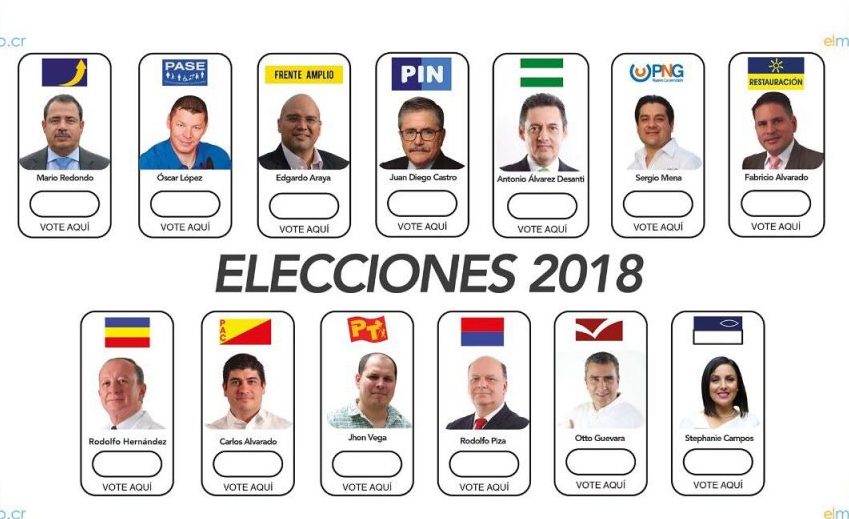
The months prior to a presidential election in any country provide opportunities for candidates to explain their government plans, their ideas and proposals. This Sunday, February 4th, Costa Ricans will be choosing their president for the next four years, and in the last poll more than 36% of the voters had not decided who to vote for.
Part of the reason for this phenomenon has to do with factors that have affected the country and distracted the attention from this very important process. The “Cementazo” case for instance, a huge corruption scandal in which many political figures were involved or mentioned to different degrees (Including the President), and more recently the same sex marriage ruling by the Inter-American Court of Human Rights which has brought religion positions into the political game.
The candidates have been interviewed , and they have participated in several debates, however, and unfortunately, the topics that have been discussed more deeply in the majority of these opportunities have been regarding same-sex marriage, religion, the candidates’ past or their integrity. The main topics such as infrastructure and fiscal deficit have been mentioned briefly and not with enough depth or detail.
36% of the voters need to make up their mind in the next two days, and it is unlikely they will have the time or the commitment to go over the government plan for the main candidates, especially since these documents tend to be long, boring and complicated for the average citizen. Unfortunately Costa Rican’s votes will be based on other factors… perhaps who they don’t like or who they like best, their family traditions, their religion or position regarding same-sex marriage, or the very little information they got from the debates and interviews.
So, what would happen, if we take the four main candidates’ positions and proposals on five key issues, summarized and simplified (as much as possible) without telling readers, at least at first, which plan corresponds to which candidate? Would leaving aside faces, history, and political colors make a difference in the voters’ decision… let’s see:
Candidate A:
Fiscal Deficit: Supports the implementation of IVA tax instead of sales tax (value added tax) but maintaining the current 13%, with the purpose of collecting taxes where they aren’t been collected yet. The containing of public expenditure(not allowing them to grow). Control tax evasion and contraband.
Infrastructure: Construction of a “metro”, the elimination of 25 bottlenecks per year and conclude seven important roads for the country.
Environment: Water treatment plants and sewers. Support for companies that implement sustainable practices and regulations and create consequences for those that contaminate the environment. This candidate is against trawling practices.
Security: Increasing the police presence, offering more and better training and providing them with better infrastructure, technology and tools to execute their work. When it comes to drug trafficking and crime, being stricter with arrest warrants and better the actions in terms of migratory administration action, there is also a proposal to create a Ministry to battle organized crime and this entity will be in charge of the Intelligence Police and the Drug Control Police.
Inequity: The creation of 200,000 new jobs in four years bringing down unemployment by 6%.; investment in technology and infrastructure.
Candidate B:
Fiscal Deficit: Modernization of the tax structure, consolidation of the expenses, transparency and accountability through the use of new technologies; bringing down the fiscal deficit to 3% of the GNP by 2022. Transformation of public expenses and renegotiation of the debt with Government institutions; be more efficient in the collection of taxes. Implementation of the value added tax going from 13% to 15%.
Infrastructure: Creation of an Electrical Train in the Great Metropolitan Area. The extension of the Florencio del Castillo road (which connects to Cartago); neighborhood roads for national production to have the easiness of transportation from rural areas; prioritizing public transportation and efficient distribution of traffic.
Environment: Creation of green corridors in the cities. Against trawling. Transforming the Costa Rica Fishing Institute into a Ministry. Promotion of the use of clean energies and efficient public transportation. Protection of water resources and ensuring the quality of water.
Security: Promotion of sports, arts and social prevention through the establishment of scholarships. Rehabilitation options through the investment in jails and the use of alternative measures.
Inequity: Creation of 150,000 jobs, focusing in the population that doesn’t work or study (ninis) and adults over 40 years of age. Promote tourism. Economic growth of 5% yearly as of 2020. Offer tools to strengthen the small and medium size companies.
Candidate C:
Fiscal Deficit: Implementation of value added tax (IVA) going from 13% to 15%. Modernization of income tax to ensure that each person pays according to their economic capacity. Containing public expenses.
Infrastructure: Electric Passenger Train. Dividing the metropolitan areas into sectors for public transportation with the idea of eliminating all the public traffic from going through the city of San Jose. Transformation of urban spaces to include areas for cyclists and pedestrians.
Environment: Creation of an Environmental tax for manufacturers and importers of non-reusable plastic containers, except those non-reusable plastics used for articles that are part of the market basket. Implementation of the National Policy of Sanitation of Residual Waters. Against trawling.
Security: Professionalization of the Police Bodies consolidating the SART mechanism, (Early Alert and Response System) and providing them with the necessary tools to efficiently carry out their work. Battling money laundering and terrorism by strengthening controls of regulatory entities; strict control over the use and ownership of fire weapons, improvement of aerial and maritime surveillance through the use of radars. Use of scanners in the frontiers to battle contraband and proper control to avoid corruption acts.
Inequity: Generation of employment with a regional focus. Establishment of economic clusters that promote national and foreign investment in different regions. Private and public alliances. Promote the advantages of each region. Promote the participation of women and the population with disabilities in the labor market.
Candidate D:
Fiscal Deficit: Implementation of added value tax (IVA) but maintaining it in 13%. Eliminating superfluous expenses like traveling and consultancies. Containing public expense. Efficient collection of taxes. Establishing new conditions for new public employees.
Infrastructure: Redefining investments. Provide ICE (Costa Rica Electricity Institute) with the authority to build public work. Develop a first world train through a concession and in strategic alliance with INCOFER. Promote the working from home modality. Transformation of the Ministry of Public Work and Transportation.
Environment: Prepare the country for electric transportation. Request the assistance and involvement of the communities in the cleaning and care of rivers.
Security: Create stronger punishments. Bring together the different police bodies so they can coordinate their work towards common objectives. Strengthen the migratory police. Restructuring jails to make them into productive spaces.
Inequity: Support the development of small tourism companies. Promote entrepreneurship. Creation of free trade zones in areas of low development. Continue with the attraction of foreign companies and strengthen the “Latin American Valley” policy.
There are thirteen candidates in total aspiring to be the next President of Costa Rica. The information above corresponds to the four candidates ahead on the last poll, these is just a small portion of the proposals listed in their government plans and have been summarized to give us a quick idea of their position on some important topics.
The summarized plans stated above correspond to: Candidate A: Rodolfo Piza (PUSC) / Candidate B: Antonio Alvarez Desanti (PLN)/ Candidate C: Carlos Alvarado (PAC) / Candidate D: Fabricio Alvarado (RN).
You can now add to the information above, the experience, the team, the capacity, and other aspects you consider important before making your choice. Each of the candidates has their complete government plan in their respective websites should you want to dig deeper or learn about their position in a particular topic.



