


 SIGN UP FOR OUR
 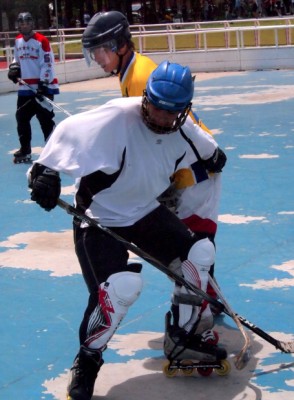 In the heart of La Sabana Park in San José, a group of die-hard fanatics take to the rink every Sunday for some street hockey; incredibly, their story spans over a quarter of a century.
Curious onlookers gather round the rink in La Sabana. Some are amazed to see players crazy enough to use full hockey gear under the blazing morning sun, while others are honestly intrigued about this sport. Jokes and camaraderie are present throughout warm-ups but once the puck drops, all friendship is put to the side. A slow skater is quickly shouted off the rink, a missed passed is bombarded with whoops and whistles and tempers can occasionally flare up.
Inline hockey in Costa Rica had originated in the early 1990’s. Several expatriates from Canada and the U.S. still had the itch to play after moving to the tropics and their first haven was located in the Parque De La Paz; a smaller than regulation rink with fences instead of boards, no roof and small benches. Still, it was perfect. Little by little, locals interested in the sport showed up and the experienced players now had the task of coaching, which they took on gladly.
“I guess we got here because we didn’t really like soccer,” says Donald Mora, one of the first Ticos to train with them, and smiles “we had to work hard to keep up with them. They explained rules, the do’s and dont’s, and fortunately we all learned properly.”
Due to administrative differences the rink in Parque de la Paz was turned to a Tennis court. The small size of the sport, compared to more popular sports, has constantly pestered its growth. ICODER doesn’t support inline hockey sustainably, sponsors are scarce and it has been fueled by the players’ passion instead.
“When the Parque de la Paz rink was shut down, we lost many of the players. Some left to create a Lacrosse league, others simply stopped playing and others changed to more ‘typical’ sports,” Mora explained, “but the core fortunately stuck together.”
All they want is to play:
“Hockey is great, it’s fast paced, demanding and very technical. Everyone has wrong perceptions about inline hockey, we are not that physical, we focus more on speed, puck handling and passing,” says Andrés Jimenez, a ‘veteran’ at 25 years old. He started playing in his mid teens and hasn’t stopped since, “Everyone here just comes to play and have fun. After all, that’s what matters.”
The need for a source of income is clearly present, as their newest rink in La Sabana is quickly wearing out. The blue paint has now chipped, leaving large spots of grey concrete. Still the smallness of the group and the lack of a governing body is a blessing in disguise, according to Andrés.
“Sports are strange here in Costa Rica,” he says, “there’s always corruption and greed. That’s what caused the demise of the great hockey days of the 90’s and early 2000’s. Some people wanted money out of this while others truly cared about making it grow; it’s the same everywhere. Now it’s only about playing, it’s more organic and I like it this way. Of course we could be better if a commission existed but we’re still just recovering. We’ve survived for so long, we’ll keep surviving.”
International play? Just maybe.
Costa Rica has had international presence in hockey, having participated in the Wide World of Sports tournament in 2002 and the Latin American Championships in Colombia in 2005. The players have their eyes set for the 2012 FIRS World Championships. Javier Monge is considered amongst them as a media manager and organizer, and he explains how hopes are dim even with respectable talent.
“Our experience outside of Costa Rica proves we’ve got what it takes to play at their level,” Monge says, “we’ve got everything set, we just lack the money for transport. We’ve tried everywhere but we’re the odd men out, other sports will have support before we do. We know it’s this way and we’ll keep pushing for support as long as we keep playing.”
Andreas De Terra, a Swiss/Tico defense man, thinks the chance to play overseas is not that far from reality.
“Look at the teams playing, Namibia is playing! They are a younger team, much younger than ours, and they are playing.” He says with an honestly jealous smile, “We know how each other plays, we’ve been playing together for years. As soon as we showcase our skills to the right person, we’ve a got ticket.”
The future is bright:
“The future is within the younger guys and they’ve been showing up,” Donald says as Javier Monge nods satisfyingly, “we train them as hard as possible and we demand what we all can from them. They learn fast.”
The Costa Rican Inline Hockey players will keep playing until their bodies give no longer and, as many other tropical countries take to the sport, they are convinced more and more talent will appear. Some Costa Ricans have even kept the hockey tradition alive after moving from here, such as Pablo Murillo in Panamá, who plays in the fast growing Panamá Hockey League.
“We’ll head over there to challenge Pablo,” says former teammate Andrés Jimenez, “we’ll see what those Panamanians can do.”
If you are interested in playing this great sport, just drop by el Parque De La Sabana on a Sunday morning, to the rink located on the southeastern corner, next to the basketball and volleyball courts.
“All we ask are three things,” Donald Mora said, “will to play, respect and safety equipment.”



