


 SIGN UP FOR OUR
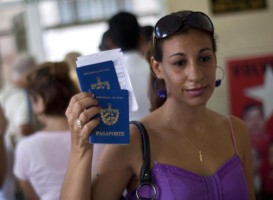 IOM Media Release – A pilot group of 180 Cuban economic migrants stranded in Costa Rica since 14 November, 2015, left shelters provided by the Government of Costa Rica and departed the country as regular migrants. They have each paid USD 555 for a commercial plane and bus tickets in a package trip to reach Mexico via El Salvador and Guatemala.
“The departure of the pilot group of Cubans should not distract from the urgent need to provide humanitarian assistance to another 7,802 Cubans who remain stranded in Costa Rica,” said IOM Costa Rica Chief of Mission Roeland de Wilde.
From 18 January, representatives of the governments of Costa Rica, El Salvador, Guatemala and Mexico will begin evaluating whether to approve the pilot as the basis for a full-fledged commercial operation to facilitate the dignified, safe, orderly departure as regular migrants of all Cuban migrants stranded in Costa Rica who have transit visas.
The unprecedented and rapid increase of stranded Cuban economic migrants has prompted the Government of Costa Rica to declare a migration crisis with an urgent need for humanitarian assistance. It asked IOM for expert advice on ways for the Cubans to be able to depart Costa Rica safely and voluntarily as regular migrants.
IOM sought a solution that would protect migrants’ rights, and identified commercial transportation possibilities that would allow the Cuban migrants to pay for their own travel.
This self-paying option reduces incentives for irregular migration and undermines criminal human trafficking and smuggling networks by creating a legal and commercially competitive alternative. None of the governments or international organizations concerned will be organizing or paying for transportation.
Miami-Dade Schools Press Release, January 12 – The School Board of Miami-Dade County will consider a proposal requesting federal support to educate thousands of Cuban refugees expected to arrive in South Florida. Superintendent of Schools Alberto M. Carvalho and School Board Chair Perla Tabares Hantman joined the voices of Miami-Dade’s Congressional delegation in calling on the federal government to provide resources, logistics, and funding necessary to address this pending influx of refugees.
The School Board will consider the action at approximately 1:30 p.m. on Wednesday, Jan. 13in the School Board Auditorium, 1450 NE 2Ave. ‘Miami-Dade County Public Schools has always afforded immigrant children arriving at our schools the same quality educational opportunities as every other child,’ said Superintendent Carvalho.
‘The local and state financial hardship that this sometimes creates has not deterred our resolve. We know that immigrant children can succeed with the appropriate instructional resources. But we can’t dismiss the fact that immigration policy is a federal responsibility. It is reasonable that we partner with our federal leaders to explore every possible funding option to ensure that every child in our school district has the opportunity to excel academically.’
Currently, it is estimated that as many as 8,000 Cuban immigrants are en route from Costa Rica as a result of a recently brokered agreement between that nation and El Salvador to transport refugees between their countries in an effort to facilitate the Cubans’ journey to the U.S. There are many more refugees throughout Latin America and still thousands more who have already arrived.
Historically, Miami-Dade County has been the preferred locale for the resettlement of immigrants from the Caribbean basin, including Cuba. Since July 1, 2015, M-DCPS has enrolled 3,934 Cuban students and more are expected. In addition to the basic cost of educating students, refugee children may require additional services because of language differences and issues related to their resettlement.
‘Our community has always welcomed refugees from across the globe with open arms however, there is a cost associated with the resettlement and education of new arrivals,’ said Ms. Hantman. ‘As the entity responsible for immigration policy, the federal government should proactively provide local governments and school districts with adequate resources and funding necessary to humanly and effectively address the needs of those immigrants, so as not to unduly burden the local taxpayer.’
Members of the Miami-Dade Congressional delegation sent a letter on January 7to the White House, requesting a plan be implemented to address the needs of these incoming refugees, including the distribution of funding and resources to impacted communities like Miami-Dade. Miami-Dade has previously requested federal funds to support the additional costs associated with educating foreign-born students.



