


 SIGN UP FOR OUR
  CURRIDABAT – Carlos Alberto Valerín lives in a modest home in the heart of a bustling suburb located east of San José, not far from the Juan Santamaría Elementary school, where decades ago his musical inclination would first become apparent. It’s the first Monday of the New Year, and Valerín (as he is known in the musical world) is busy messing around with the settings of a wireless router. “I just had this thing installed, and I want to make sure is configured correctly”, he mentions as way of apology. “I like keeping up with what’s going around in the musical world through Facebook, and I want to be able to move freely around the house with my laptop.” He further explains that his birthday was the day before -New Year’s Day- and he spent it recovering from an ailment. “I played a lot of gigs over the holidays, especially during New Year’s celebration. I was exhausted and may have caught a bug while playing.”
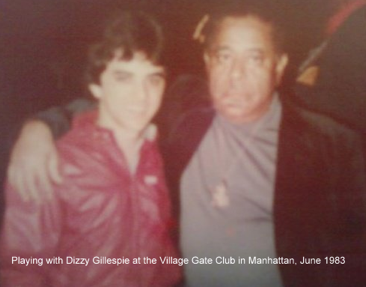 Once he is certain his wireless router is working properly, he proceeds to show me some photos in his media kit. I ask him about a photo where jazz legend Dizzy Gillespie has his arm around him. “That was at the Village Gate in Manhattan in the early 1980s. I was really young.” And what about this other picture with Celia Cruz? “Oh man, eso fué in Miami in the late 1990s. I really miss her.” Those are just two of the big names Valerín has played with. While researching this interview, I learned that he has played with Latin jazz greats like Arturo Sandoval, Machito (Francisco Raúl Gutiérrez Grillo), Víctor “Vitín” Paz, and Tito Puente Jr. On the salsa side, he has played with Johnny and Ray, Louis Cruz, Johnny Colón, Eddie Palmieri, Johnny Ventura, Ray Maldonado, and many others. How did a Tico trumpet player from Curridabat end up playing with so many luminaries? To hear Valerín tell the story, being at the right place at the right time had a lot to do with it.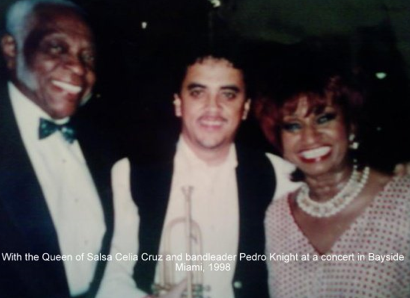
The Golden Age of Salsa
For Valerín, the right place was New York, and the right time was no less than the second half of the Golden Age of Salsa. While salsa music and Latin jazz are two musical genres that are still vibrant, music buffs generally agree that salsa was born in New York as a result of a mix of different Latin American musical cultures. The Afro-Caribbean rhythms of guagancó and son laid out the foundation for boogaloo and other tropical fusions with jazz and rock.
There’s endless dispute about the precise origins of salsa, and with apologies in advance to purists at Fania and other hardcore salsa communities, for the sake of this interview we will go with the assumption that the Golden Age of Salsa begins with Johnny Pacheco’s Cañonazo album in 1964 and ends with the sad passing of Héctor Lavoe in 1993. We will also take a midpoint in the Golden Age of Salsa, and that would be the groundbreaking 1978 Rubén Blades album Siembra, a perfect mix of socially-conscious salsa with a good amount of disco thrown in for good measure. Fast forward a couple of years, and Valerín begins his music trajectory.
The Costa Rica Star: You were very active in the salsa and Latin jazz scene in New York from 1980 to 1993. How did you end up in that situation?
Valerín: I went on tour with Karibú (a pioneering salsa band from Limón) to New York City. After a few gigs I realized that I was in the heart of it all. I began taking classes with Maestro Carmine Caruso and kinda stayed in New York after that.
The Costa Rica Star: Are you the only Tico musician who has been part of that important period in salsa history?
Valerín: Until 1993? I think so, yeah. José Sibaja arrived in the mid 1990s, but before that I was the only Tico, at least that’s what I think. That made me a bit of an outsider.
– Valerín speaks English with an American accent that’s a little New York Bronx by way of Calle Ocho in Miami, generously sprinkled with Tico slang. Having returned in earnest to his native land a couple of years ago, the linguistic adjustment is evident.
Valerín: There was a time in New York when I was chastised for sounding like a Tico. My mentor, the great Vitín Paz used to scold me for using usted and being shy when I spoke, like we do here. He said that I had to learn to talk in Spanish like the Cuban, Panamanian and Puerto Rican musicians. They speak in notes, with sabor, like it’s in their blood to do so.
The Costa Rica Star: You are talking about the great Maestro Victor Paz who has played with Frank Sinatra, Antonio Carlos Jobim and Tony Bennett, among others. How did he become your mentor?
Valerín: Believe it or not, I was riding a subway train in New York when I met him! He taught me so much, and not just trumpet lessons, but about life in general. He hooked me up with Machito.
The Costa Rica Star: Dizzy Gillespie credits Machito as the bandleader who forged Latin jazz. You ended up playing with both. What was that like?
Valerín: Oh bro, I still can’t believe it. Look, I met Arturo Sandoval in La Habana in the late 1970s. I was studying at Conservatorio Castella and we were invited to play at this festival. Back then I was so overwhelmed that I could only dream of seeing him again, which is exactly what happened after he left Cuba. When I was a young kid, we only had long play vinyl records and the radio to listen to and the album covers to look at. So you had to dream big. It’s different today. Now with the Internet we can get closer to our idols. I keep up with Arturo Sandoval and other musicians via Facebook. But playing with Dizzie and Machito at Village Gate in Manhattan was something else.
The Costa Rica Star: And you met Wynton Marsalis there?
Valerín: Yeah, backstage. He was warming up and I didn’t know who he was. He had just finished studying at Juilliard, I think. We’re about the same age, you know. I remember two things: he had amazing breathing techniques, and he was a humble man who stopped to shake Ray Maldonado’s hand after a trumpet solo.
The Costa Rica Star: Let’s talk about Ray Maldonado. He really was a shooting star. He left us too early, right?
Valerín: Man, he was so talented and such a good friend. So many people don’t know about his influence on Stevie Wonder. He’s the one who really drilled into me that practice and tenacity pays off in music. I mean, he played with Lionel Hampton and Fania All Stars, and there I was playing with him. It was amazing. I was devastated when I found out that he passed away, I had just spoken to him that morning.
The Costa Rica Star: And then you played in a movie named Crossover Dreams.
Valerín: Yeah, that was another trip. I was in Johnny Colón’s Orchestra when we got the call. I remember being in a rooftop in New York and playing while a young Rubén Blades is acting a romantic dancing scene with a beautiful actress.
The Costa Rica Star: The director of Crossover Dreams, León Ichaso, would go on to direct “El Cantante”, the acclaimed film about Héctor Lavoe’s life, starring Marc Anthony and Jennifer Lopez.
Valerín: I only found that out years after, when my media kit was created. I saw Hector Lavoe perform at the Village Gate during “Salsa Meets Jazz”, which was like this really cool project where musicians got together to jam and groove instead of the dance-heavy sessions we played at clubs like El Corso, The Palladium and The Copacabana.
The Costa Rica Star: Those are legendary New York clubs. You played at all those?
Valerín: Yeah, that was with Johnny Ray’s Salsa con Clase. The band’s still around, but I don’t know about the clubs.
The Costa Rica Star: The Copacabana reopened in 2011.
Valerín: Really? Oh bro, that’s cool.
The Costa Rica Star: But the Village Gate is now a CVS Pharmacy.
Valerín: That sucks. Hey, it’s time for coffee. Would you like a tamal?
– We continued the interview over steaming pork tamales.
The Costa Rica Star: Was Miami also part of the Golden Age of Salsa?
Valerín: I guess you could say that. When you’re playing at the Calle Ocho Carnaval, it certainly feels like it. I was there playing with Orquesta Inmensidad, which was the Miami house band for Celia Cruz when she came to Miami. Man, people in Miami loved her, and she was humble and so real and genuine with everyone.
The Costa Rica Star: You recorded an album with Orquesta Inmensidad, Un Nuevo Amanecer, which just happens to be the last recording released under the old Fania catalog, the same catalog on which Johnny Pacheco’s Cañonazo appears. That’s a record collector’s favorite, as well as a couple of other albums in which you are credited…
Valerín: You know, I wasn’t really aware of these communities of collectors of jazz and salsa stuff until recently, but I see why they are interested. I wish I had kept some of those records. I am a journeyman musician, didn’t record much but spent thousands of hours onstage. I have found groups like Salsa Brava on Facebook that are so dedicated to what you would call “Golden Age of Salsa” stuff. It’s nice that they want to keep it alive. I mean, that also happened in Cali, Colombia, where salsa from that period ruled.
The Costa Rica Star: Do you see that happening in Costa Rica now? A renewed interest in salsa from the time when men wore guayabera shirts and reeked of Old Spice while women the shortest and tightest dress they could fit into?
Valerín: Yeah, I see it when I’m out there onstage [laughs]. Maybe not the Old Spice. The dancers are keeping it going. From my spot on the stage I have seen the bailarines doing their stuff for years, and what I’m seeing these days in our country is incredible. Just walking around San José and the neighborhoods you see all these dance academies, and those lessons seem to be paying off. So I guess I have Tico dancers to thank for keeping me in business [laughs].
The Costa Rica Star: When you get up there to play these days, it must feel different from New York.
Valerín: It feels better. It’s home. I love the interaction between the band and the audience, and getting congratulations from people you don’t know. Running into old friends and fellow musicians and talking shop. I must admit that when I returned I was still in transition, indeciso, trying to figure out my next move, but I’m now involved in some nice projects that will keep me here.
The Costa Rica Star: One of those projects is La Salsa Más Larga del Mundo (World’s Longest Salsa Recording). I’ve heard portions; it sounds retro. Can you tell us more about it?
Valerín: I know the project’s director, Alex Arias, from my time in Miami. So he comes up with this idea to create something that goes way back. A big band “salsa dura” number, something that Tito Puente would play. I was one of the early musicians called up for the project, which was originally planned for like, 15 minutes with about as many musicians. It’s now like 44 minutes and over one hundred musicians from around the world are involved. And you know what? It’s a great song that you actually can dance to. It’s also a way of letting people know that salsa is not dead.
The Costa Rica Star: I can understand the retro revival idea. We’re seeing that now in the rock and soul genres with artists like The Black Keys, Adele and Fitz and the Tantrums. But why record such a long song?
Valerín: To illustrate the spirit of collaboration among musicians. It’s supposed to break a Guinness World Record, and we may be able to take it out on tour. It’s a throwback to the old school extended jam sessions of Latin jazz. The documentary is also very cool.
The Costa Rica Star: I also saw on your media kit that you intend to work with Tamela Hedstrom, a Tica singer-songwriter who has achieved international pop success.
Valerín: Yeah, she has recorded at SoloHits, where I’m an inhouse studio musician now, and if in the future she decides to add trumpets to her projects -I will be there. We are good friends.
The Costa Rica Star: She’s so talented and enchanting. We’d like to interview her one day. Would you put in a good word for us?
Valerín: Yeah, I can do that.
The Costa Rica Star: I have on my notes here that you are also sponsored by Fides Instruments.
Valerín: I am a representative for Fides trumpets in Central and Latin America -an endorser to be precise. Fides sponsors high-caliber artists, like classical prodigy Rubén Simeó in Spain and Luis Aquino in Puerto Rico; I’m not quite there yet [laughs].
The Costa Rica Star: Simeó and Aquino are pretty big names. How did you get involved with Fides?
Valerín: Through my friends Ernesto Núñez who plays for Juan Luis Guerra and 440, and also Gerry López in Florida. He introduced me to the Fides sound, which is something else. These are European trumpets… Made in Germany. We are talking about high quality and prestige. I thought it would be a good idea to bring them to Costa Rica. We have very talented and skilled musicians, and they should be complemented with the right instrument.
The Costa Rica Star: Are they good trumpets for salsa performers?
Valerín: That’s the thing, they are so versatile. Many classical musicians are playing Fides, but the salsa and Latin jazz world has really taken to them. Look, Fides is a big reason why I’m sticking around here instead of trying my luck as a session player abroad. It’s a big project for me. I know we can elevate Costa Rica’s status in the international musical field with Fides Instruments.
The Costa Rica Star: I wanted to ask you about that. Our country has recently enjoyed an uptick of interest in the international musical stage thanks to artists like Tamela Hedstrom, Debi Nova and Son de Tikizia, what do you think the future holds for Tico musicians?
Valerín: The success of Son de Tikizia and Walter Flores is very well deserved. The artists you talked about deserve it too. But what many Ticos don’t realize is that we have musicians like Checko D’Avila who has played with James Brown -he’s the owner of SoloHits. We have extremely talented brass technicians like Allen Torres. Then we have Ticos who shine in the classical music field in other countries, like Wálter Morales who is an accomplished pianist and orchestra director in the United States. In the salsa world alone, I invite you to listen to bands like Son Mayor, Madera Nueva and Erick Sánchez. They may be playing at some downbeat cumbia joint in the middle of nowhere, but the professionalism and musicianship is there. That’s one thing about Tico musicians: they don’t play to be in the limelight -they play because they are devoted to music.
The Costa Rica Star: Thank you Maestro. Happy New Year.



