


 SIGN UP FOR OUR
 By Wendy Anders
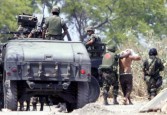
Mexican soldiers fighting the Drug War. Wikimedia Commons
A recent political analysis of the region raises questions about the continuation of a militarized approach to illegal drug trafficking in an era where the decades long US sponsored “war on drugs” has been repeatedly called a failure.
From 2004-2014 the United States provided $768 million in police and military aid to the region, ostensibly to counter narcotics traffic. The region spent an additional 2 billion on weapons, 75 percent of which were purchased by Honduras.
Although Costa Rica has no standing army, they were the second largest arms purchaser in the region over the last decade spending $142 million dollars, slightly above Panama’s $132 million (which also does not have a standing army), and well below Honduras $1.5 billion military expenditure which went largely to revamp their army in 2011 with arms from the U.S. and Israel, said the study.
The Costa Rica-based think tank “Estado de la Nación” or State of the Nation, undertakes annual country level and regional analyses. In their 2016 report on the Central American region released this week they state, “The revitalization of the armed forces and their growing participation in civilian activities, added to the chronic weakness of judicial systems, and the existence of new, large corruption cases in several countries, presents risks for the democratic exercise of power. The fight against delinquency and narco-traffic has opened the door to militarization for the sake of citizen security.”
In recent years, the U.S. has provided military and police assistance under the Central American Regional Security Initiative (Carsi) with stated goals being to decrease crime and contraband, strengthen governance, increase governmental controls in vulnerable communities, and increase cooperation and coordination between countries in the region.
The countries in the region with standing armies have all increased in size over the last decade, with Guatemala’s and El Salvador’s increasing by 50 percent over a six-year period. From 2008-2014 their armies reached 22,326 and 24,799 actives respectively; and a total of 73,033 people in the region are on active military duty, stated the 2016 State of the Region report.
Costa Rican Foreign Minister Manuel González said in response to the new report that there are no real threat of wars in the region, and feels there is no justification for the high military investment and increases in the region’s armies.



