


 SIGN UP FOR OUR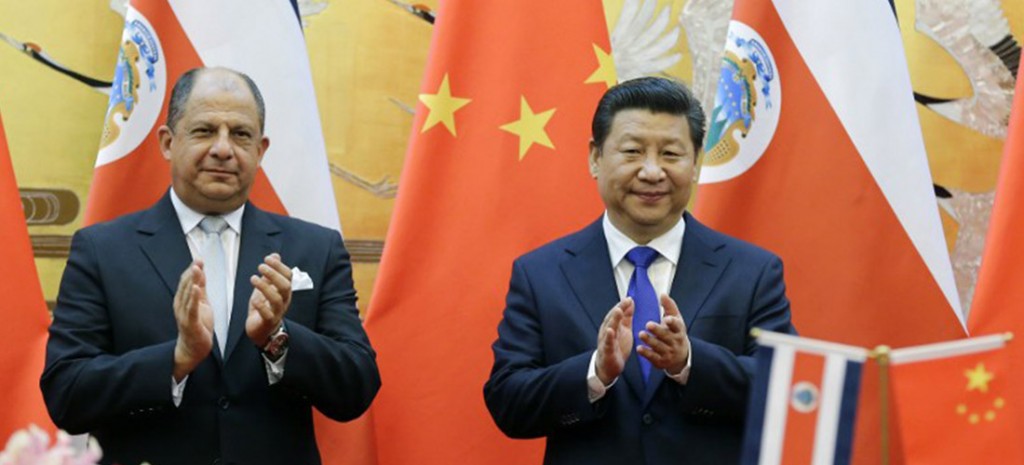
(Photo courtesy of Casa Presidencial)
Chinese loans to Latin American and Caribbean governments and the region’s state-owned firms climbed sharply in 2015 despite the slowing Chinese economy, rising to US $29 billion and focused once again on Venezuela, Brazil and Ecuador, the Inter-American Dialogue public policy think tank said in its annual report issued this month.
From nuclear power plants in Argentina to infrastructure projects in Costa Rica, the volume of finance was the highest since 2010 and marked a nearly 200 percent increase from the US $10 billion registered in 2014. Some US $400 million of those funds went to Costa Rica.
Chinese bilateral loans to the region eclipsed the combined lending to the region by the World Bank, the Inter-American Development Bank and the Development Bank of Latin America, known as the CAF, Kevin Gallaher, a Boston University professor and coordinator of the report, said at a press conference.
Gallagher said the data showed that China was increasing its lending to Latin America at a time of cutbacks by other institutions, including the World Bank and the IDB, whose loans to the region fell to $8 billion and $11.5 billion last year, a decline of 8 percent and 14 percent, respectively.
He added that a key development this year was that a majority of the Chinese loans were for infrastructure projects as opposed to the extractive industries, as in years past.
Brazil received $10.65 billion last year, followed by Venezuela with $10 billion and Ecuador with $7 billion.
Bolivia received $850 million in state-to-state financing from China, while Costa Rica and Barbados obtained $400 million and $170 million, respectively.
Costa Rica, like other Latin American countries, find Chinese funds often have strings attached
Costa Rica, like other Latin American countries, has found that Chinese financial assistance often comes with strings attached.
After announcing a US $24 million grant from China with his counterpart, Chinese President Xi Jinping in January of last year, Costa Rican President Luis Guillermo Solis was forced to reveal a month later that the grant had certain stipulations attached by the Asian powerhouse.
Speaking to reporters in February of last year, President Solis conceded that the agreement dictates that many of the projects funded with the grant must involve the hiring of Chinese companies to perform the works, adding that the agreement came with “various conditions.”
A few months later, in May 2015, it was also revealed that a plan put forth by China Harbour Engineering Company (CHEC), who as part of a loan deal, the Chinese mandated carry out works to expand Route 32 which connects San Jose and the Caribbean port city of Limon, lacked even the most basic road safety requirements.
Former president Laura Chinchilla originally agreed to a $395 million dollar Chinese loan for the project, which stipulated that the country was to hire CHEC to carry out the works.
Amongst some of the fundamental safety requirements lacking in the company’s plans were lighting, demarcation, drainage problems, and lack of shoulders along the roadway.
Also lacking in the plan was standard earthquake reinforcement of bridges that would be built or expanded as part of the project.
Ricardo Castro, chairman of the Infrastructure Committee of the Costa Rican Chamber of Construction (CCC), said at the time: “The project lacks basic topographic studies and even designs, and the conditions of the loan are not favorable.”
CHEC responded by saying that the “additional” safety features would come at a “substantial increase” in cost, while Costa Rican officials insisted they were sold on the deal as a “turnkey project.”
Chinese loans often more costly
Paulina Garzon of the China-Latin America Sustainable Investment Initiative noted last year that “the terms [of Chinese financing] are not really the best for Latin America,” noting that Chinese loans are often more costly than loans from the World Bank or the Inter-American Development Bank.
While Beijing typically lends at 7 to 10 percent over 12-15 years, the multilaterals usually do so at around 4 percent over 18-25 years.
EFE contributed to this report.



