


 SIGN UP FOR OUR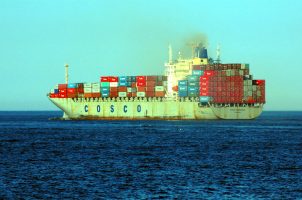
Wikimedia Commons
To be able to celebrate the Panama Canal expansion is, for many Panamanians, experiencing a milestone of their ancestors, who witnessed the first transit through the waterway 102 years ago, so they went out today to dance, which is how they express themselves best.
The afternoon of Jun. 26, when the Chinese container ship Cosco Shipping Panama made the inaugural transit through the third set of locks, Hector Osorio put on a shirt that said “Panama is fashionable” to celebrate on the Cinta Costera waterfront boulevard in Panama City.
The ship arrived from Greece and whose final destination is South Korea, measures 48.25 meters (158 feet) abeam and 299.98 meters (984 feet) long, and has a capacity for transporting 9,400 containers. It paid a toll of close to $586,000 for sailing through the new set of locks.
“When it was passed in Panamanian hands, no one thought that Panama could sustain the Canal, and we have shown that we can sustain it and that it can be expanded. It makes us feel good as citizens,” Osorio told Efe, waving the flag of Panama.
Unlike when the canal was inaugurated in 1914, “the Panamanians were those who worked on this expansion”, which employed 36,000 locals of a total of 40,000 people from 79 countries, something that Osorio, an employee of the State University of Panama for 23 years, applauded.
On the promenade in Panama City, hundreds of people responded to music from orchestras and spiced up the grand celebration. The main focus was on the locks of Agua Clara (on the Atlantic) and Cocoli (on the Pacific) where some 20,000 enjoyed the inaugural voyage that mimicked the great feat of the Ancon ship in 1914.
“102 years ago we did not have the chance to be there and today we do” thanked Jorge Branda, a father who traveled from the western outskirts of the city to “be part of history.”
To the rhythm of Panamanian reggae, Branda told Efe how proud his compatriots feel “to be the people who will serve the world. This is a great achievement,” one that he wanted to witness to then tell his daughter, who was carrying a little flag in her arms.
“This is a story that began with the flag. By placing Panamanian flags in areas that the US had influence” after the Torrijos-Carter Treaties were signed in 1977, he said while showing his small flag as evidence of this achievement.
The new locks, which can accommodate ships that carry up to three times the cargo than before, claimed the Panamanian “vocation” of service to the world and the extension “broadens our horizons to serve the world in a special way,” said the young Edward, who is very aware of its historical context.
Today was the day for Panamanians, and “everything went smoothly, everyone behaved as they should have behaved,” according to Isora Carmona, a septuagenarian dressed in Panamanian flag colors, who, despite the sunset, continued dancing in the middle of the crowd. EFE
Panama, Jun 26 (EFE)



