


 SIGN UP FOR OUR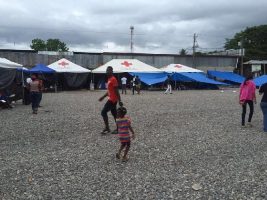
Source: Red Cross Costa Rica
The livelihood of foreigners who choose to live as perpetual tourists in Costa Rica is highly dependent on the stability of the land borders. It so happens that in recent months both the northern and southern borders of Costa Rica have been afflicted by the global migrant crisis; how is this affecting the lives of perpetual tourists?
“Visa runs” are those trips taken by perpetual tourists, mostly from North American and European countries, to renew their legal permanence. Although visa runs can be undertaken at any port of entry, including airports and maritime terminals, most perpetual tourists choose the border checkpoints at Peñas Blancas and Paso Canoas for this purpose.
To understand how these borders are holding up for perpetual tourists on visa runs, it is important to review recent events:
As reported by The Costa Rica Star last year, the Peñas Blancas checkpoint was compromised when the Nicaraguan government deployed soldiers to the border with a mission to block and repel Cuban migrants crossing Central America on their way to the United States. Thanks to political wrangling and a humanitarian airlift, thousands of stranded Cuban migrants eventually made it across.
A few months after the impasse at Peñas Blancas, the southern border with Panama was rushed by Cuban and African migrants who are also in their way to the United States. This time, the government decided to close the border, a move that has been equally lauded and criticized.
Although many people in the Americas are familiar with the plight of Cuban migrants as they try to take advantage of the U.S. Cuban Adjustment Act and the bizarre “wet foot/dry foot” policy, this familiarity is virtually absent in the case of the African refugees currently stranded in Costa Rica.
Most African migrants in our country are from the Democratic Republic of the Congo (DRC), a nation that achieved independence from Belgium in 1960. Unfortunately, the DRC has been trying to recover from a conflict known as “Africa’s first world war,” which led to the loss of some five million lives between 1994 and 2003. Major hostilities resumed in 2008; essentially, they have not stopped.
According to a recent investigative report by Dearbhla Glynn of the Irish Times:
At the height of the conflict, in 2006-7, 48 woman were being raped every hour [in the DRC].
Armed unrest plagues the DRC to this day. Geopolitical analysts often cite tribal warfare and strife among ethnic groups, but Ms. Glynn of the Irish Times is more succinct than that:
Congo is one of the most resource-rich countries in the world, with coltan – a metallic mineral refined for use in electronics – gold, oil and diamonds. The harvest in Congo could theoretically provide food for all of central Africa, yet the country imports $1.3 billion in food.
The wealth of the DRC, like its women, has been raped by dictatorships and rebel forces that operate in a criminal manner.
The spokesperson for the hundreds of Congolese in Costa Rica, many of them families with young children, is the only man who speaks Spanish. A few weeks ago, he explained to our international news wire partner Agencia EFE that a deportation to the DRC could result in a certain execution by government death squads or armed groups affiliated with tribal warlords.
The first intention by Costa Rica to deport the Congolese has subsided amidst criticism. One of the most scathing critiques was launched squarely at President Luis Guillermo Solis by Mario McGregor, a popular football play-by-play expert at Radio Columbia.
During a match broadcast, Mr. McGregor called out President Solis for having helped thousands of Cubans reach the U.S. and skip Nicaragua while turning a blind eye to the Congolese. Mr. McGregor, an Afro Costa Rican from Limon who is intensely proud of his roots, correctly mentioned that President Solis has openly spoken about his Afro Caribbean heritage (his grandmother was from Jamaica), yet he has fallen short of helping the Congolese from the Mother Continent.
The situation for the Congolese in Costa Rica is uncertain. Red Cross volunteers, may God always bless them, are taking care of them with shelter, nourishment and medical attention, but the future is unknown.
Britt Nelson, political columnist for The Costa Rica Star, recently traveled to Panama and got a first-person look at the situation down there:
I saw a tent city on the edge of Paso Canoas, Panama. We had gone to a local gas station to do some shopping and many of the migrants were sitting around idle — men and women and children. They were on the Costa Rican side of the border.
They appeared in despair. Lonely, sunken faces, no emotional expressions. Driving by, I made eye contact with several who were sitting along the road. They were expressionless. They just stared at me. Several hundred of them were sitting along the road outside the fence of the enclosed/gated tent city.
I could see that some effort was being made to accommodate these people, who have been on the run and in harm’s way. In town, the situation was normal. There was the usual police presence, but there were no riots like a few weeks ago in front of the Costa Rica immigration offices.
Mr. Nelson filed the report above immediately upon returning from Paso Canoas. Later, he expanded:
When I saw [the Congolese] on the side streets of Paso Canoas, they were idle and looked as if they felt forgotten. Children clung to their parents or family members with looks of despair. Those kids looked hungry and sad as I looked at them while driving by.
My goodness; this flood of humanity moving from country to country to avoid certain death in their homelands needs to stop. But how?
Borders are closing, doors are being shut in their faces leaving them not only homeless, but hopeless and broke without a country to call home.
The tent city I saw… I suppose that is Costa Rica’s effort to help in some way. Many of [the Congolese] had been living on the streets [of Paso Canoas].
It’s apparent that these migrants are seeking passage through Costa Rica on the way to the U.S. border are being moved out of sight to the edge of town, but let’s hope they are mot moved out of the hearts and minds of Costa Rica and Panamanian immigration authorities.
In the end, Mr. Nelson mentioned the outcome of his trip:
I had no problem getting a 90-day tourist visa renewal.
And thus it can be assumed that an important aspect of perpetual tourism has not been affected by the migrant crisis in Costa Rica; however, those who travel to Paso Canoas for this purpose are bound to encounter the sights described by Mr. Nelson.



