


 SIGN UP FOR OUR
 In Costa Rica, from February until April, before the rainy season begins, many folks inquire about repairing leaky roof and flashing installations. There are several methods to troubleshoot and solve roofing problems. Following 20 years of inspecting residential and commercial construction here, I’ve witnessed mostly quick fixes that temporarily solve leaky roofs. Quick fix repair methods are nothing more than band-aids on open wounds and the homeowners are seldom satisfied and usually blame the contractor when the leaks continue. I’ve found that it’s not prudent to participate in projects unless quality building materials and proven installation methods can be utilized to solve the client’s problems. That way, the clients are not inconvenienced by the contractor needing to return a second time to complete the renovations to the client’s satisfaction.
The following photos and descriptions are of the most frequent construction defects I’ve discovered during my 20 years of construction inspections in Costa Rica and I’m detailing the most suitable methods to solve the problems 100%.

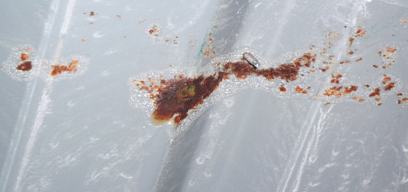
One method that the locals use to maintain their roofs is to periodically paint the metal laminates with anti-corrosive paint. Anyone who has purchased paint in Costa Rica knows, the paint is expensive and usually doesn’t last more than a year on a roof down here under the intense ultraviolet rays of the sun, less than 10 degrees from the equator. When the paint peels off the metal laminates, as in the above photo, it’s a lot of work to clean the loose paint and prepare the surface for another coat of new paint. If the roof surface is not maintained consistently with sufficient anti-corrosive paint, corrosion begins on the exterior surfaces of the laminates as well as on the undersides of the laminates and spreads as the metal is exposed to further moisture.
In Costa Rica, the majority of roofing systems are undulated metal laminates screwed into light weight wood or metal structures. Because underlayment is seldom used, there is nothing preventing moisture from infiltrating into the overhanging soffits. Additionally, the part of metal laminates that overhang the gutters is exposed to a great deal of moisture and when corrosion begins on the bottom of metal laminates, it spreads like cancer.

The ends of the laminates that overhang the gutters can be cut with a small grinder with a metal cutting disk in order to remove the corroded part of the metal laminates and make space for the installation of a membrane product.

The installation of a membrane product on the roof surface and down into the back of the gutters seals the gap where water infiltrates inside the soffits as well as eliminates the corrosion that grows under the laminates.

If the gutters need to be replaced in the future, the membrane can be cut loose from the gutters with a razor knife and doubled up onto the roof surface during the installation of the new gutters. Then when the new gutter installation has been completed, the membrane can be re-applied with a torch onto the back of the new gutters in order to seal the gaps again.
In a few instances, I’ve inspected roofing installations where plywood underlayment was utilized. However, drip edge flashing is rarely used and when the gutters fill up during heavy rains, the water backs up onto the underlayment and causes the plywood to warp as well as entering inside the soffits and onto the fascias. The absence of flashing is one of the most common problems here in Costa Rica and most local tradesmen don’t know how to properly install flashing materials.

The shortcomings of these types of inferior roofing installations result in a variety of damages to dwellings. When rainwater builds up in the gutters, it flows out from the back side where the gutters are attached to the roof structure. Once the water is inside the overhangs, it causes moisture damage to the ceilings of the soffits and eventually becomes visible on the exterior of the soffit ceiling materials.

Additionally, this same water accumulating inside the gutters flows onto the fascia materials and eventually stains the surface. These soffits and fascias in these two photos have cementitious laminates for the finished surface, commonly referred to as “Fibrolit” here in Cost Rica. These laminates were not designed to be taped and plastered like drywall and therefore cracks are always visible where they join together.

During the past few years, materials such as green drywall and Densglass laminates have been used to cover the soffits and fascias and when these products become moist from water infiltration, the tape and plaster along with the synthetic materials utilized to fabricate the laminates becomes damaged. These modern materials are much more complicated and expensive to repair than the typical cementitious laminates. The old cementitious laminates don’t deteriorate rapidly like the modern materials and the local custom here is to paint the cementitious laminates every year to hide the water stains and mold. So if you’re looking at homes, other than during or just after the rainy season, the soffits and fascias may appear clean because they’ve recently received a fresh coat of paint. Only an experienced construction inspector with a keen eye can spot the tell tale signs of water infiltration once it’s been covered with fresh paint.

All of the above problems were caused by the gutters filling up with rainwater and overflowing inside the soffits and onto the fascias. The most common cause of gutters filling up with rainwater is the lack of maintenance. If the gutters are full of debris, the holes for the downspouts become blocked and the water can’t escape.

In the past, most gutters did not have downspout tubes and the custom was to install small cone type drains, commonly referred to as “conos” in Costa Rica. Then the locals install chains inside the conos to divert the flow of rainwater. However, these chains obstruct the flow of water and cause the rainwater to accumulate inside the gutter.

Furthermore, many gutters were fabricated with small drains and very little water can flow out through a tiny little hole.

Metal roofing laminates expand and contract under the intense ultraviolet rays of the sun in Costa Rica. When they move, sometimes they don’t fit back together evenly and in these gaps is where driving rains enter and cause moisture damage to interior ceilings and in attics.

Additionally, when metal laminates move, the screws unfasten themselves and create larger holes where moisture can enter into the ceiling cavity and cause interior damage. In the photo below, you can see that this metal roof structure has corroded from water infiltration through gaps in metal laminates. This is a serious problem that is difficult to repair and if allowed to continue will cause deterioration of the structures strength and replacement will be extremely expensive. This photo was taken in the attic of a home in Escazu that was only three years old and constructed by a local commercial contractor.

In the real world, most structural supports are installed every 24 inches on center in order to support adequate underlayment laminates and roof coverings.

In Costa Rica there is little code enforcement and many times, in order to save money, contractors install roof supports every 36 or 48 inches, thereby using fewer structural supports and saving money.

Unless the design of the roof structure included thicker gauge supports, there is little possibility of adding an underlayment product after the fact, because lightweight structures cannot support the additional weight of underlayment laminates that are installed to support tiles and other heavy roofing products.

When roofing maintenance is necessary and workers need to walk up on the roofs to make repairs, the metal laminates collapse in between structural supports that were spaced too far apart from the weight of the workers. In these indentations, moisture accumulates and causes corrosion of the metal surfaces.

The most cost effective method to solve all of the above problems and prevent water infiltration into the attic, ceilings, soffits and fascias of dwellings is to apply a membrane directly onto the metal laminates and down into the gutters.

This membrane product is 4mm thick, SBS, Styrene-Butadiene-Styrene, elastomeric modified bitumen product. The method I use to connect the pieces of the membrane and attach them to the metal laminates is a heat application process and we use propane torches to melt the membrane and attach it to the exterior surfaces in order to seal the openings where the filtration of water is entering.
For additional protection, I paint the membrane with a 100% acrylic elastomeric waterproof coating that protects the membrane and insulates the roof surface to help reduce the effects of the intense ultraviolet rays here in Costa Rica.

Additionally, where the roof meets the vertical walls I install the membrane up the walls to seal the joint where the roof structure meets the vertical walls. With the membrane heat applied to the metal laminates and concrete walls and then the waterproof coating applied to the membrane, this is a 100% solution that is guaranteed for 15 years.

Once I seal all the previous gaps that allowed infiltration of water, I need to ventilate the attic and soffit cavities. The installation of aluminum vents in the overhanging soffits allows air to circulate through the attic and soffit cavities.




