


 SIGN UP FOR OUR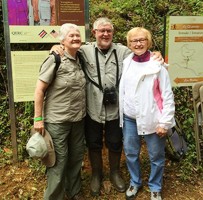
Leo and Zana Finkenbinder. Source: Olivet Nazarene University
Olivet Nazarene University Press Release – An innovative educational and research facility in a Costa Rica cloud forest has been named for Dr. Leo Finkenbinder, zoology professor at Olivet Nazarene University, and his wife, Zana. The couple has worked for more than three decades in that region to advance scientific knowledge and ecological sustainability.
Leo and Zana Finkenbinder Hall is part of the Quetzal Education Research Center (QERC) field station in San Gerardo de Dota, a town in the Talamanca Mountains in Costa Rica’s south central Pacific region. The Finkenbinders co-founded the field station in 1986, when Dr. Finkenbinder was a professor at Southern Nazarene University. He joined the Olivet faculty in 2007.
The couple has made many trips to the region and conducted a wealth of research there. For 12 years, Zana Finkenbinder served as director of logistics at the research center.
“Zana was the construction foreman for this building complex,” Dr. Finkenbinder says. “It is a testament to the ability of different cultures to build a first-class science laboratory. Our lives have been so enriched by the help of so many people.”
QERC began from a relationship among Southern Nazarene, Dr. Finkenbinder and Efrain Chacón, one of San Gerardo de Dota’s first residents. The Chacón family pioneered the settlement of Costa Rica’s Savegre Valley in 1955. About 50 Chacón family members were among the crowd on hand to celebrate the naming of Finkenbinder Hall. At the same time, the family also announced the Leo and Zana Finkenbinder Sendero (trail) as the new name of the primary trail at the research center.
The Finkenbinders have worked with the Chacón family in transforming the family’s industry from dairy farming and logging to sustainable use of the land and care of the cloud forest. As the relationship developed, the Chacón family allowed the researchers to bring university students into the valley for their studies.
This partnership — QERC — resulted in the construction of a small laboratory in 1996, plus a larger, state-of-the-art educational and research facility in 2001.
Now, QERC provides research education opportunities to students from Olivet and Southern Nazarene. Because of this facility and the Finkenbinders’ work, students, scholars and the community of San Gerardo de Dota can engage in field biology education and research while promoting biodiversity, sustainability and social responsibility.
“We have worked with more than a thousand students at the QERC,” Dr. Finkenbinder says. “Watching students develop research skills, in a tropical cloud-forest ecosystem, has been an amazing journey. I continue to hear from QERC alumni telling how much the experience they had is still having an impact on them. Many of them have gone on to research careers of their own.”
During summer 2014, Daley (Schimmelpfennig) Morera ’14 worked as a student intern at QERC, an experience she says is one of the best and most impactful of her life. She saw firsthand the results of the Finkenbinders’ work in the Savegre Valley. Today, Daley is in a Ph.D. program for biochemistry and cancer research at Augusta University in Georgia.
“I was enriched by the time I spent at QERC, and my time at Olivet was enriched even more by knowing and being mentored by the Finkenbinders,” Morera says. “I can only hope to leave a legacy like this one day. I aspire for my work in the laboratory to reflect my desire to serve God and His people just as I have watched Dr. Leo and Zana live this out in their lives.”



