


 SIGN UP FOR OUR
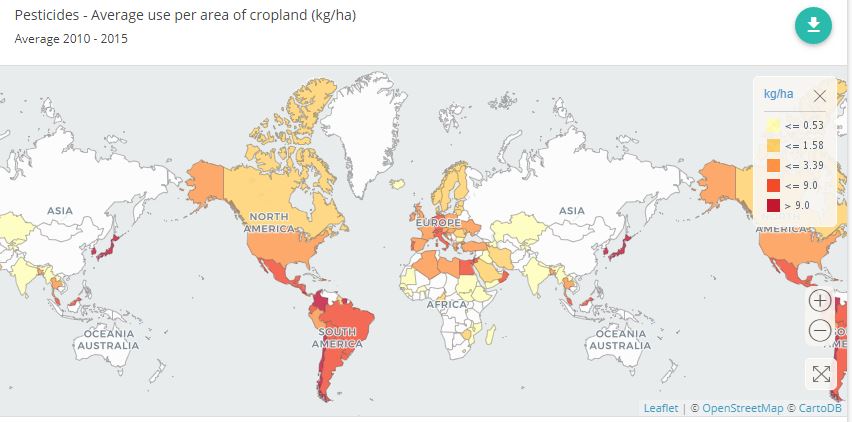
According to data by the Regional Institute of Studies of Toxic Substances (IRET) of the National University (UNA) in Costa Rica, the country uses on average an alarming 18.2 kilograms of pesticides per hectare of cropland.
The information, published by local newspaper Semanario Universidad, establishes that when compared to other countries, Costa Rica takes first place in the world, followed by China where they use in average 17 kilograms per hectare of cropland.
As a comparison, a country like the United States uses close to 2.5 kilograms per hectare of cultivated land.
This data raises major concern over the uncontrolled use of pesticides which are associated in many cases with risks of environmental contamination and pose different risks to health.
The use of pesticides has been decreasing slowly in Costa Rica since 2010, when, according to a report by the World Resources Institute, the country was consuming as many as 23 kilograms of pesticides per hectare of cropland; the number went down to 20 in 2011 and reached 18.2 in 2013.
The estimation used by the Food and Agriculture Organization of the United Nations (FAO) -of use per hectare of cultivated land- does not include pastures.
In addition to the excessive use of pesticide, field studies have shown the use of unauthorized pesticides; the Ministry of Agriculture is aware of the situation but has no way of controlling it.
The use of pesticides and other toxic substances of synthetic origin have been associated with different health problems such as cancer, infertility, allergies, intoxication, among others. They have also been the cause of contamination of water supplies and reserves.



