


 SIGN UP FOR OUR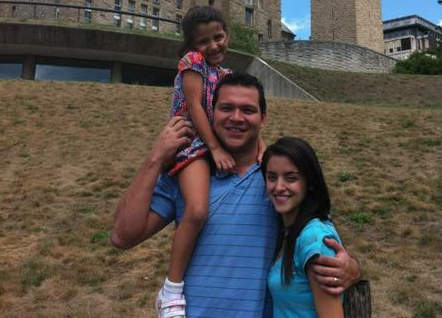
Alvaro Salas-Castro is not your average graduate student.
When Alvaro, 27, his wife Carla and their daughter Valentina arrived in Ithaca a month ago so that Alvaro could attend the Cornell Institute for Public Affairs he posted this message to the supporters who donated funds on Rally.org so that he could move with his family from Costa Rica to attend Cornell:
Dear Friends, Supporters, allies and guardians for a better society:
As you can imagine I feel quite emotional and overwhelmed as my family and I are settle in Ithaca New York beginning my studies in one of the leading schools on public policy in the world. After sleeping on the floor in an inflatable mattress for the past week with no internet connection or communication devices whatsoever I have been able to connect deeper with my roots and have some quality time with my family, to assess, think and recharge the energy I will need for this fight.
Salas-Castro raised $100,000 dollars through the online platform and other initiatives to cover the costs of relocating and attending Cornell that were not covered by the fellowship offered to him by the university. The goal, he said, is to get the education he needs on how government works in order to return to his country and make a difference in the public sector. But while he is learning about good government in the classroom, he will be practicing transparency with the supporters who helped get him into the classrooms. With his creative team of advisors, he will develop reports every six months to send to donors to show how the money is being spent.
“Every six months we are sending to all our donors a report of what I’m doing with their money here in the states,” Salas-Castro explained. “Like, we bought these books, we bought these clothes, we’re paying these tuition fees. Why? Because we want to walk the talk. It’s not only talking about transparency, we have to live it. So if somebody wants to attack my campaign, I say I’m an open book, go check them. That’s the idea. It’s a huge responsibility. And I know that I have a huge responsibility.”
One thousand people contributed to his fund — Alvaro Salas’ Education Funding for a Peaceful Central America.
“I’m here to prepare myself to start a fight, and I’m not the only fighter in this struggle,” he said. “There’s a lot of new people, new generations that are preparing themselves to try to mitigate or to tackle these problems. And the problems that we see and we’re facing right now, the first one that I think is the most dangerous is the current problem that we have with the drug lords and the cartels in our region. Basically, we are in the middle of the drug route from the producers’ countries in the south to the consumers in the north. Since our country abolished their army fifty years ago, we don’t know how to protect our streets, and things are getting out of control. And our education system is failing us; six of every ten students in high school are dropping [out].
“So basically that tells you that in the next ten years more than fifty percent of our new generations are going to be uneducated,” he added. “And education is the key to mobilizing a society. And if you add that we have these cartels recruiting them with incentives, so we’re sitting actually in a time bomb. Adding to that, our leaders, our current leaders, have been involved in corruption scandals. We have two former presidents in jail and the transparency and accountability from the public officers is almost inexistent. So that’s why we want to leverage some education here in the state and better understand how public policies are implemented, how government is run and try to apply this learning and tools back in our country.”
Raised by a single mother, Salas-Castro earned a basketball scholarship at a private school. But after a knee injury, he lost his scholarship. Salas-Castro explained that he became depressed, his grades started to go down, he was expelled and he began making “bad friends.” But when a childhood friend was killed by gangsters for his bicycle, Salas-Castro decided to make a change in his life.
He began working as an assistant to Jose Aguilar Berrocal at the Fundacion Accion Joven, a NGO that aims at mitigating high school drop-out rates. He went on to receive a B.A. in International Affairs from the Universidad Latina de Costa Rica, a diploma for study in Diplomacy, Foreign Policy and International Business at the Universidad Latinoamerica de Comercio, and a law degree from the Universidad Autónoma De Centro América.
Recruited by a private sector company to an assistant position, Salas-Castro ended up serving as regional vice president for the company for Central America at the age of twenty-three.
“At that particular point in time we were making some money and achieving a lot of results in the corporate ladder, but I just felt that it was not self-fulfilling for me. It was not fulfilling, it was not fun like the times working in the foundation,” said Salas-Castro.
Receiving a Leaders for Change scholarship, Salas-Castro went to study at INCAE business school, focusing on economics, finance and sustainable development. Despite the different fields he gained experience in, Salas-Castro still felt he needed to understand how to run effective public policies to make a difference in the public sector, and he applied to several graduate programs including Cornell. He was offered a scholarship through Costa Rica’s Ministry of Science and Technology for his studies, but when he went to collect the funds, he was told there was no money for him because the scholarship funds were used to build a new building.
With the offer from Cornell on the table, Salas-Castro began looking for funding to supplement the scholarship offered to him by the university in order to attend. After looking for loans and other sources of funding, Salas-Castro remembered Tom Serres, the CEO of Rally.org who he met in Panama.
“I just put it in perspective,” said Salas-Castro. “Why I want to go to Cornell and study is actually to implement it in my country — to help more people, to create more opportunities, actually to tackle these problems. So that’s why I can actually try and leverage that. It’s not only for me. I’m not going to make money from this. The salaries in my country that go to the public sector are the lowest and you’re going to be subject to scrutiny and stigmas. And actually the worst position in the world is going into public office in a third world country. And I want to do that because I want to change that. Walk the talk, change by example and trying to encourage other new generations and other young guys to believe in that, make things happen.”
It took two months to raise the funds on Rally. Salas-Castro and his team organized activities — reggae and rock concerts and fundraising dinners.
“The teenagers and the people in the young generations were supporting me,” Salas-Castro said. “They came to the concerts to show me their support and they donated to the campaign. The most important businessmen from the country donated money to me as well because they believe that the government is failing and they believe that we have to prepare new generations for a succession plan. The academia, the civil sector, the civil society, the NGO’s — all of the constituents in the country came to the fundraising dinner, supported me, told their friends, made this happen. I went to the mass media, TV, radio, newspapers asking for support. And the people of Costa Rica, particularly the young generations started believing in the process.”
Salas-Castro credited his wife as his balance throughout the process.
“She believes in this craziness,” he said. “Because it’s crazy, what we do is crazy. And right now, we raised $100,000 dollars to be here. And at the end of the day, that is the output. We are here. But the outcome is to prepare ourselves to better understand, to pick the right courses, to pick the right internships that are linked to the issues that we’re living with in the region, particularly in Costa Rica. And then, start a fight from the grassroots, from the bottom to the top.”
Salas-Castro said he was looking forward to finding an internship and engaging with the Ithaca community.
“I really like this place,” he said. “I chose it first of all because there really is a sense of community here. People really respect each other. They try to support each other. I think it is the nicest city I have ever been in my life. Imagine if we can leverage the sense of solidarity that you have here in our part of the region, in Central America. Which is unfortunately, the lack of confidence from the people, it’s very individualistic. There’re just bystanders. Indifference to problems. That’s not good at all.”
“I just feel very blessed to be here,” he emphasized. “I see my classmates are super worried about the workload and stuff like that, but I’m just enjoying it. I was working today until 2am in the morning and I’m super happy. Zero complaints. I would sleep here on a bench to be part of this community. And what I would like to say to the new generations is that to have the opportunity to be educated, to be part of a community like this, less than one percent of the population of the world has opportunities like that. And what we need is more people devoted to use that education to pay it forward to create more solidarity and awareness, not only for our own benefit.”
To learn more about Salas-Castro’s fundraising campaign visit rally.org/alvarosalasgoestocornell.
Source: Ithaca.com



