


 SIGN UP FOR OUR
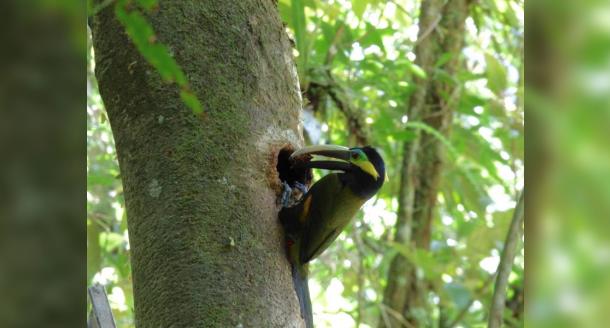
Costa Rican scientists documented for the first time the nest of a yellow-eared toucanet (Selenidera spectabilis), the species of toucan that is hardest to see in the country because of its shyness and of which little is known in terms of reproduction biology.
Tourism guides from the company Rainforest Adventures whose property is in close proximity to the Braulio Carrillo National Park, found the nest back in 2016 and after identifying it, documented the progress until the birth of four baby yellow-eared toucanets all deteails and information was documented with the description of the nest, which is a hole in a tree, took measurements and followed the development of the babies in the nest that are feeding with insects and fruit.
“The yellow-eared toucanet is very hard to see, it lives in primary forests of Central America and the Northeast of Colombia and Ecuador. This is the first time that the whole process can be documented”, explained guide Alan Rodríguez.
This information has allowed experts to include all the details of this species reproduction that were previously unknown.
“This toucan is not very common, it is not seen every day, just maybe a few days a year, and it’s not found in many places”, said Rodríguez.
The yellow-eared toucanet is the only toucan that shows sexual dimorphism, a condition in which the two sexes of the same species exhibit different characteristics beyond the differences in their sexual organs; in their case the male has a yellow auricular streak, while the female has a brown crown.
Costa Rica is home to six species of toucans.



