


 SIGN UP FOR OUR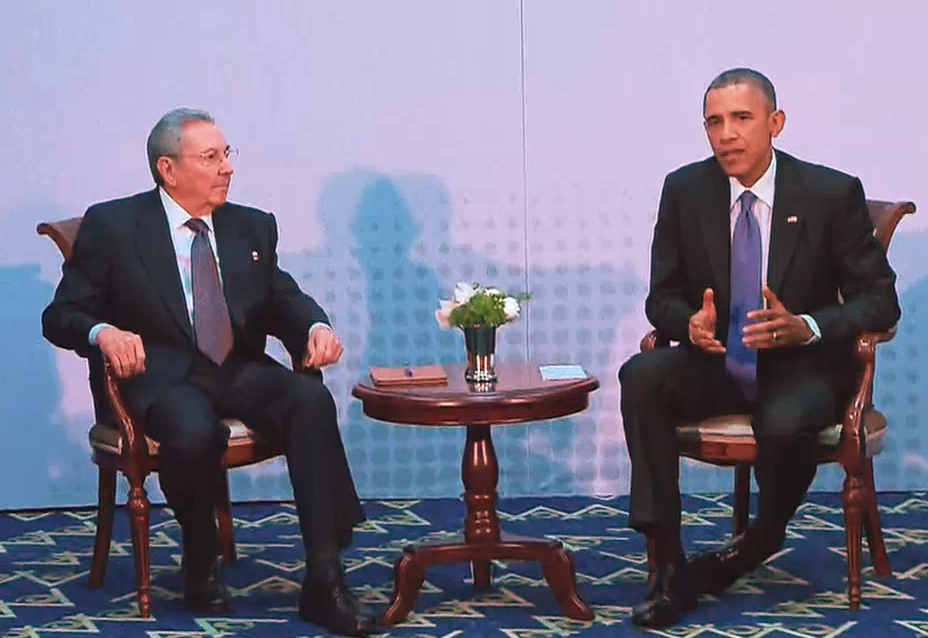
(FILE / White House photo)
Editor’s note: This story was updated on March 14, 2016 at 3:48 p.m. (GMT -6) with quotes obtained by the EFE news agency.
Despite a long editorial by the Cuban government last week in state media stating that the communist island has no intentions of changing its policies and demanding that Washington cease meddling in its internal affairs, U.S. President Barack Obama has promised in a letter to the prominent Cuban dissident group Ladies in White that he would raise human rights issues with Cuban President Raul Castro during his visit to the island nation next week.
Obama said he understood the struggles of the Ladies in White, but defended his policy of seeking to normalize relations with Cuba.
Ladies in White, a group made up of wives and children of Cuban political prisoners, has strongly criticized the U.S. president’s policy change.
The group said the Castro regime continues to suppress anti-government dissent and maintains a monopoly on the media. They also said authorities have cracked down more since the two countries announced plans to normalize relations in December 2014.
“We take seriously the concerns you have raised,” Obama wrote in English.
“I will raise these issues directly with President Castro,” he said, praising the Ladies as “an inspiration to human rights movements around the world.”
“I fully understand the obstacles that ordinary Cubans face in exercising their rights,” Obama wrote. “The U.S. believes that no one in Cuba or anywhere else should face harassment, arrest, or physical assault just because they are exercising a universal right to have their voices heard,” he said in the letter that was confirmed by the White House.
Last week, deputy national security adviser Ben Rhodes, one of the architects of Obama’s Cuba policy, traveled to Miami as part of a listening tour ahead of the president’s historic trip.
Rhodes spend Friday meeting with Cuban-American students, activists, members of Cuba’s civil society, exiled Cubans and journalists.
He said he told the groups the White House goal isn’t to topple the Castro government, but to open up society through diplomatic and trade relations.
“The fact of the matter is we don’t have any expectation that Cuba is going to transform its political system in the near term,” Rhodes said Friday. “Even if we got 10 dissidents out of prison, so what? What’s going to bring change is having Cubans have more control over their own lives.”
Appreciated letter
Ladies in White leader Berta Soler, who read the letter to about two dozen members and other supporters in Havana, described Obama’s missive as positive feedback and the group greatly appreciated it.
The leader of the Ladies in White, Berta Soler, told the EFE news agency that Obama’s letter “is very important because it acknowledges that in Cuba there has been no progress in matters of human rights, and also recognizes the existence of the Ladies in White.”
Soler said that her group wrote a letter to the U.S. president on Jan. 28 in which “we said we are very concerned because nothing has changed in Cuba, nor has the Obama administration expressed any disapproval of the Cuban government so that it stops the police violence and declares an amnesty for political prisoners.”
After the traditional march of the Ladies in White on Sunday after leaving Mass at Havana’s Santa Rita Church, Soler met with her colleagues and other opposition activists at a nearby park and denounced the “harassment, threats, arrests” and the “resurgence of repression” following the diplomatic thaw between Cuba and the United States.
She also said that in recent days they have received warnings that during Obama’s March 20-22 stay in Havana, “they won’t let us go into the streets,” then used the moment too send an invitation to the U.S. president to come and meet with the Ladies in White at Santa Rita Church.
Obama will visit the Caribbean nation March 20-22. It will be the first visit by a U.S. president since Fidel Castro’s rebels overthrew a pro-American government in 1959.
On Monday, Obama told U.S. diplomats at the State Department that his upcoming trip to Cuba would begin a new era in relations with the country.
“And diplomacy, including having the courage to turn a page on the failed policies of the past, is how we’ve begun a new chapter of engagement with the people of Cuba. What a historic day it was when [U.S. Secretary of State] John [Kerry] reopened our embassy in Havana. And next week I look forward to being the first U.S. president to visit Cuba in nearly 90 years without a battleship accompanying me,” he said.
President Calvin Coolidge, in January 1928, was the last U.S. president to visit Cuba.
The Ladies in White hold weekly anti-government protests during Sunday Mass at the Santa Rita Church in Havana.
In a well-practiced choreography, officers stand by until the women shout “Freedom!” and try to sit on the street outside the church. The protesters are then whisked off to police stations and empty schools, held for hours, released and driven home. They return the following week.
They plan to protest when Obama visits on March 20.
Castro regime says it has no intentions of changing policies
Last week, Cuba said it would welcome Obama’s visit but the Communist government had no intention of changing its policies in exchange for normal relations with the United States.
In a long editorial last Wednesday in Communist Party newspaper Granma and other official media, Cuba demanded that Washington cease meddling in its internal affairs and said that Obama could do more to change U.S. policy.
Cuba objects to U.S. support for its political dissidents, whom some Americans consider champions of human rights but whom the Cuban government views as an unrepresentative minority funded by U.S. interests.
The editorial further reinforces calls made by Cuban President Raul Castro in December that the US respect his country’s national sovereignty.
In a December address to Cuba’s Parliament, Castro said the communist island nation would “never accept conditions that tear at [its] sovereignty and dignity.”
The US shouldn’t believe that normalization will lead Cuba to abandon its independence, economic or social systems, Castro added during his December address to Parliament.
Material for this report was contributed and obtained from VOA, Reuters and EFE and is used with permission.
Information on living in and tours to Cuba and vacation rentals in cuba.



