


 SIGN UP FOR OUR
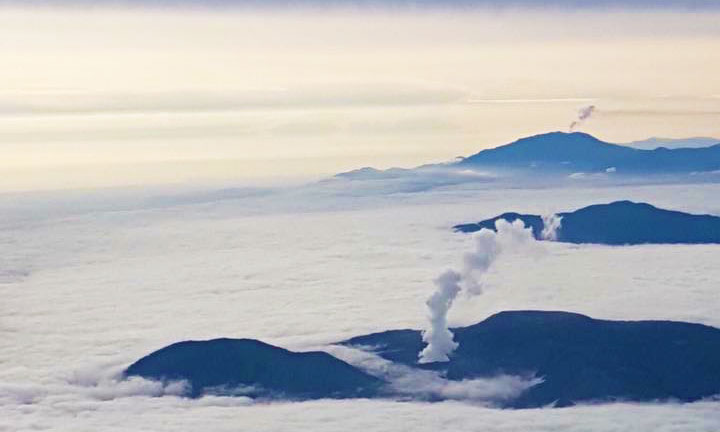
Poás Volcano had another eruption that reached an altitude of over 1 kilometer this Friday morning and could be easily seen from many spots of the metropolitan area.
Since 11 p.m. on Thursday night the National University’s Volcanology and Seismology Research Institute (OVSICORI) reported an increase in the tremor which fluctuates in intensity; the majority of the events expel only water vapor but some also carry sediments, small rocks and small quantities of ash.
According to studies and measurements carried out by OVSICORI, the vapors of the volcano are affecting the quality of the air in the metropolitan area, shooting up the contamination to levels that exceed the permitted values of the World Health Organization (WHO).
Residents of San José, Alajuela, Heredia and Cartago are breathing high levels of sulfur, carbon dioxide and occasionally ash particles, that can have a negative effect in health.
The air quality monitoring station located in Hatillo, registered in average a concentration of carbon dioxide of 81 parts per billion (ppb), with a maximum peak of 99.1 ppb, which exceeds the WHO limits of 75 ppb.
According to Jorge Herrera, coordinator of the environmental laboratory of the National University, the emissions of gas by the Poás Volcano are affecting the quality of the air in the metropolitan area which was already compromised with the eruptions of the Turrialba Volcano, and of course the contamination produced by cars and industries.
The other monitoring stations located in Coronado, San José and Alto de Ochomogo, Cartago also marked high concentrations of gases.
The high levels of sulfur dioxide and carbon dioxide measured near the crater of the volcano are interpreted by scientists as a sign of fresh magma near the surface.
The combination of this gases in the air and heavy rains like the ones experienced in the last few days create what is known as acid rain, which causes damage in crops, vegetation, and even metallic structures.
In the next few days the OVSICORI and the Ministry of Health will be setting up a monitoring station in Fraijanes and another one in Grecia with the idea of having real time information of the quality of the air and provide information to the population and suggest measures accordingly.
Images from the thermal cameras located in the National Park:



