


 SIGN UP FOR OUR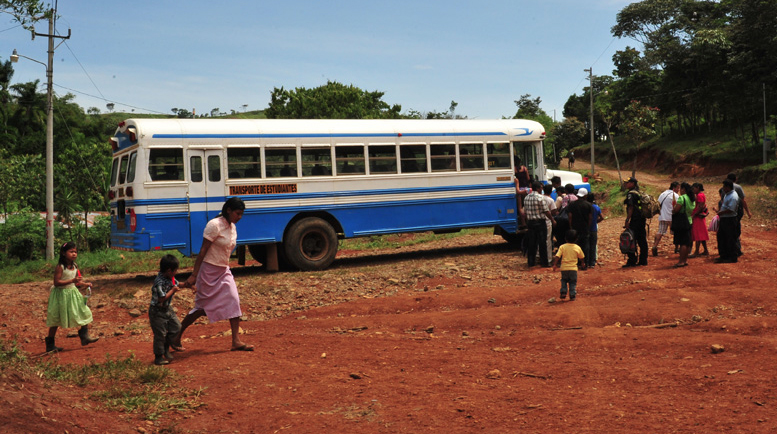
Note: You can go to The Costa Rica Star Facebook page to view a large photo gallery related to this article.
Puntarenas – It’s 1pm, the last public bus from Cabagra prepares to leave, the inhabitants gather, a trip among steep ways lies ahead. The indigenous territory of Cabagra is located in the canton of Buenos Aires, province of Puntarenas, in southern Costa Rica. The population is made up mostly of the Indigenous Bribri Group, however, their culture and language have been much affected by the neglect of their customs and the mistakes of public schooling.
To the inhabitants of Cabagra, the Ministerio de Educacion Publica or MEP (Ministry of Public Education) is perhaps responsible for the fact that Costarican indigenous populations are losing their customs, given the lack of teachers who are qualified to strengthen the native language, which prompts children and teenagers to lose interest in their roots.
Most of the children can’t speak Bribri, some can write it and others are not familiar with it at all, only in the most distant and isolated sectors are the people’s customs preserved.
The families are organized into Clans, governed by the mother. Future generations will have the mother’s and not the father’s clan. There are about 10 types of clans amongst them including the Urúriwak, Tsíbriwak, and Kòrkwak. People of the same clan cannot wed, or it would be considered incest within the Bribri culture.
Farming is the source of development and employment for the inhabitants of Cabagra, who cultivate corn, coffee and sugar cane. However, they do not have an effective means to commercialize their products which causes loss of crops and money.
To some of the inhabitants it is the duty of the Asociacion de Desarrollo (Development Association) to make way for the products that come from these lands, many of them must sell their products at low costs to merchants who sporadically show up from different parts of the country.
“We have to practically give away the products to people who come from Buenos Aires, Cartago or San Jose” commented Simon Torres, native of Cabagra.
The population of Cabagra also feels threatened by the Diquis Hydroelectric Project, the biggest in Central America, which the Instituto Costarricense de Electricidad or ICE (Costarican Institute of Electricity) is proposing. Despite the fact that it will not affect the area directly, the inhabitants fear for the environmental damage the project will cause, for the ICE intends to flood close to 7,000 hectares, including a large part of the Terraba-SierpeTerritory, taking with it sites of international interest and great cultural importance to the indigenous peoples.
The Diquis project with an approximate cost of $2 billion, requires 915.59 hectares of indigenous territory, which according to ICE are not permanently inhabited. It will also impact the Interamericana Sur highway, flooding a strip of 3.2 km, which will be replaced by a bridge which could become the longest in the country.
The project is currently halted, since it is awaiting approval from the Secretaria Tecnica Nacional Ambiental (SETENA), entity in charge of conducting studies on the socio-environmental viability of the project.
To the inhabitants it is important that ICE considers other means to generate electricity and satisfy demand for the future, without the need to mistreat the earth and the roots of the native peoples of America.
Graciously provided to The Costa Rica Star by Gustavo Gutierrez Sanchez of GGS Photography.



