


 SIGN UP FOR OUR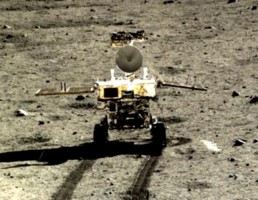
“Yutu” by Chinese National Space Administration/China Central Television
Madrid, Dec 23 (EFE).– China’s Yutu robot, which landed on the moon in 2013 as part of the unmanned Chang’e-3 mission, has found a different type of basaltic rock on the Earth’s satellite, a study published in the journal Nature Communications said.
Chang’e-3, the first probe to reach the lunar surface since the Apollo and Luna missions four decades ago, landed in a volcanic area that had not previously been studied in detail.
The Yutu rover traveled around the Zi Wei crater in the northern region of the Imbrium basin gathering data.
Although data collected by lunar orbiters indicated the presence on the moon’s surface of a variety of volcanic rocks, soil samples had not been collected until recently.
A team from Shandong University’s School of Space Sciences led by Zongcheng Ling presented the first results of analysis of data collected by Yutu’s instruments in the article.
Indications are that this relatively young region of the moon, formed some 2.96 billion years ago, has unique mineral features, suggesting the presence of a type of basaltic rock not detected by previous missions or in lunar meteorites.
Chang’e-3’s landing site was specifically chosen to study a relatively recent flow of lava with a nearby crater, where the impact of a meteorite may have brought different materials to the surface.
These are pioneering observations in a region of the moon’s landscape not previously explored and will help advance knowledge of some of the youngest volcanic areas on the satellite, the article said. EFE



