


 SIGN UP FOR OUR
  In the early 80’s, Costa was an entirely different place than it now is. With a population only approaching the two and a half million mark, there was hardly any congestion at all, no traffic problems, no real crime and certainly no violence.
Back in those days, from San Isidro del General to Dominical was a three and a half hour trip just to get there, and if the trip were by bus, the passengers frequently had to get out and push the bus across a river ford just before arriving. Now it’s about a 35 minute trip in a car going over paved road all the way.
Things started changing somewhat with the La Penca affair in Nicaragua in 1984, with Costa Rica, Eden Pastora (“Commander Zero”) and the Sandinistas, and many Nicaraguans began bailing out and coming to Costa Rica.
By 1987, the country’s population had reached about 2.7 million and many changes were becoming apparent: it became commonplace to have to stand in lines, crime rates rose, violence grew, people suffered more daily stress, and everyone thought the economy was going to hell in a hand basket because everything was becoming more expensive.
By 2007, the population had increased to 4.4 million, a 59% increase in the 20 years since 1987 that was accompanied by a large increase in the number of drivers in Costa Rica, crowded streets, crowded cities and crowded major thoroughfares. In 1984, there was one car for every 12 residents; now there is one car for every four.
Virtually all the country’s roads have exceeded their capacities, as have all other public services such as the Caja, the electrical grid, the water supply, law enforcement, and the judicial system. The Internet, which originally was a pristine superhighway, is now like the country’s network of roads: overcrowded, slow, and with many potholes. Ditto the telephone services, especially the cell phones.
As of July, 2011, the country’s official population has risen to approximately 4,576,562. Considering all of the above, and that much of Costa Rica is unusable for development, at least for the present, because of its mainly mountainous terrain, inaccessibility factors, and vast natural reserves, I began wondering if Costa Rica might be on the verge of overpopulation. Most certainly it is becoming overcrowded in comparison to what it once was, way back in the 80’s.
An informal survey reveals that 9 out of 10 Ticos believe the country is overpopulated, but because of the seeming reticence of many Ticos to talk about it with me, I decided to dig deeper.
It turns out the hemming and hawing was because Ticos do not really believe their country is overpopulated by Ticos, but is overpopulated because of all the foreigners here. This is not to say they necessarily resent the foreigners, but do recognize that there seem to be many here.
According to figures provided by the Dirección General de Migración y Extranjería, the largest number of foreigners living in Costa Rica are, of course, the Nicaraguans, (250,267), followed by the Colombians (22,727), then the US citizens (15,633), the El Salvadorans (8,568), Cubans (8,418), Chinese (6,615), Panamanians (5,674), and the Venezuelans (3,578) as of June 30, 2011.
The total from all the many countries represented here is 364,694 and with the apparently large number of illegal immigrants living in the country, the number of persons pending residency approval, and number of perpetual tourists living here, the total amount could easily be close to 500,000 foreigners in all. Another way to put this is that one out of every ten persons here is a foreigner.
Another factor is that with the annexation of Guanacaste in 1824, the Nicoya area became part of Costa Rica, although it wasn’t until 1958 that this was formally recognized. Thus the residents in that area all became Costa Rican citizens, but the acculturation process has been somewhat slow for many, and Ticos are very proud of their own cultural heritage.
For example, I am a Costa Rican through naturalization, have blood lines here, have spent almost half my life here, am fluent in Spanish, vote in the national elections, and for all intents and purposes, consider myself a Tico. But the truth is, I will always be a gringo, and my Costa Rican family members affectionately refer to me as “el gringo loco”. In this same way, Nicas, at one level, are considered foreigners.
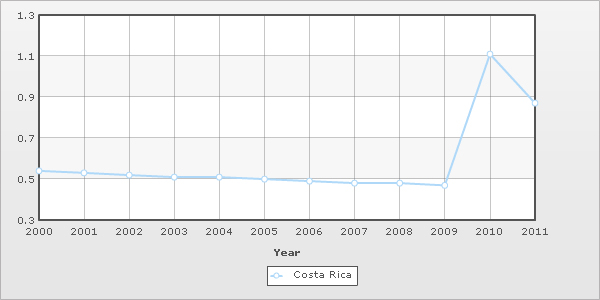
As can be noted on the graph above, there has been a sharp spike in the migration rate between 2009 and 2010. This, of course, is significant, but highly so when one considers that unlike most countries, Costa Rica, like the United States, considers anyone born in Costa Rica to be a Costa Rican citizen. This means that once here and giving birth to a child, the door is completely open to permit all immediate family members to be here as legal residents.
This may be an important factor when the tipping point comes with regard to Costa Rica’s population. Of course, overpopulation and overcrowding are two different but closely related concepts. Considering the country’s infrastructure problems, I would say the country’s current population is definitely greater than the capacity supported by the infrastructure.
But on the other hand, the future looks good for Latin America in general, and if Costa Rica can rid itself of many of the outdated vestiges of colonialism it has inherited, and continue to join and participate in the opportunities presented by technology, and dedicate itself to serious and coordinated efforts to actively plan for the future, then perhaps there is a great deal of hope.
In looking at the country as it is today, it becomes obvious that the common factor running through all the problems the country faces, especially now with so many citizens, is the lack of efficient planning that includes long range population studies.



