


 SIGN UP FOR OUR
 NOBEL MEDICINE 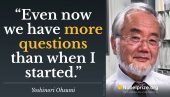
Tokyo, Oct. 3 — Japanese biologist Yoshinori Ohsumi, who won the 2016 Nobel Prize in Physiology or Medicine for discovering the mechanism of cellular autophagy, underlined Monday the importance of challenges.
After hearing about his win, the 71-year-old scientist told media outlets the recognition by Stockholm’s Karolinska Institute was an honor because his study was in basic medicine.
Ohsumi, who works at the Tokyo Institute of Technology, has been recognized for discovering the process of degradation and recycling of cellular components, known as autophagy.
The scientist said luck played an important role in his discovery, and advised the youth that while not all scientific research may be successful, it is nevertheless important to set challenges for oneself.
Ohsumi – the sixth Japanese to win a Nobel Prize in medicine – said he had always wanted to do something that other people might not do, according to public broadcaster NHK.
While announcing the award, the Sweden-based institute had said Ohsumi’s discoveries have “led to a new paradigm in our understanding of how the cell recycles its content,” and added that his research opened a path to understanding the fundamental importance of autophagy in many physiological processes, such as adapting to starvation or responding to an infection.
Like other Nobel winners this year, Ohsumi will receive a diploma, a medal and 8 million Swedish krona ($938,000). EFE



