


 SIGN UP FOR OUR
 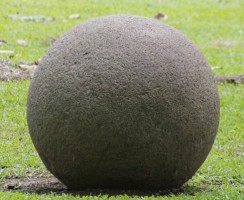 Workers digging a secondary drainage canal for a banana plantation in Costa Rica’s Osa canton discovered what is just the latest in series of stone spheres that raise more questions than they answer for archaeologists.
Locally the stone spheres are known as Las Bolas. Over the years just over three hundred of them have been discovered across the Diqius Delta and on Isla del Cano in Costa Rica. The stone spheres range in size from just a few inches to over six and a half feet in diameter. Some of them weigh as much as fifteen tons. This latest Las Bolas artifact measures fifty-five centimeters in diameter.
Work on the drainage canal stopped immediately when the sphere was found and workers called the National Museum. The sphere is already being prepped for safe shipment back to the museum in San Jose. Along with the Las Bolas the remains of pre-Columbian pottery and tools were discovered at the site, a former rice field, which has never before been excavated.
These stone spheres were first originally discovered by the United Fruit Company in the 1930s. Workers bulldozed the spheres out of the way of the company’s banana plantations until rumors began that they had centers of pure gold. Countless spheres were dynamited for their mythical gold centers before archaeologists intervened. Since their discovery the spheres have found permanent homes outside many museums, hospitals, and government buildings across Costa Rica. Many of the smaller finds have ended up in the private collections of wealthy buyers around the world. In Costa Rica they remain something of a status symbol for the rich.
A lot of myths and speculation have surrounded the spheres. It is said that they are perfect in roundness, a feat thought to be impossible for a hand carved stone. This myth persist despite scientific calculations that prove they are as much as two inch out of round and that years of damage and erosion has greatly altered their size and shapes. In the 1970s Erich von Däniken’s book “Chariots of the Gods” speculated that the stones were alien in origin while others over the years have linked them to the lost city of Atlantis. Local mythology about the spheres says that the ancient people who created them possessed a potion that softened the stone and made it pliable to being molded into a round shape.
Archaeologists dismiss the many wild stories surrounding the stone spheres. They have, hesitantly due to the difficulty of dating the rock, linked them to the Diquis culture that flourished between 700 CE and 1530 CE in what is now Costa Rica. Dating has been further complicated because it is not unusual for the stone spheres to be discovered with the remains of several different cultures artifacts. Archaeologists have proposed theories ranging from boundary markers to that old favorite astrological calendar as the purpose for the spheres.
Costa Rica recently announced plans to create a Park of the Stone Spheres and their hopes that the site will become a UNESCO World Heritage Site.
Source: Examiner.com



