


 SIGN UP FOR OUR
 Asuncion, Oct. 12 — Paraguayan Indians on Wednesday expressed their rejection of an Oct. 12 national holiday marking the anniversary of Christopher Columbus’ arrival in the Americas and also denounced the expulsion of indigenous peoples from their ancestral lands.
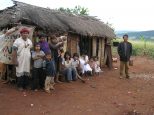
Pai Tavytera indigenous in Paraguay, Wikipedia
Leaders of 75 Indian communities who are part of the Coordinating Body of Indigenous Leaders of the Lower Chaco, or CLIBCh, held their demonstration outside the Paraguayan Congress building in this capital.
Milciades Gonzalez, a member of the Sanapana tribe, said the “plundering and massacre of the indigenous began with the supposed discovery of America.”
“For us, there’s nothing to celebrate” on Oct. 12, a holiday known in Paraguay as the Day of the Race, he said.
“Just a constant struggle for some wellbeing in our communities, because there are many needs, as well as rights violations because we’re unable to have our own land,” Gonzalez added.
Gonzalez belongs to the Xakmok Kasek group, which in 2010 obtained a favorable ruling from the Inter-American Court of Human Rights that forced the Paraguayan government to return a 10,700-hectare (41-sq.-mile) expanse of its ancestral lands.
The Xakmok Kasek had been expelled from that territory in the 1980s by U.S. rancher Roberto Carlos Eaton Kent.
The Paraguayan government subsequently reached an agreement to buy a portion of that territory from its owner and, following several indigenous protests, is currently paying for those lands.
But that is the lone case in 2016 in which the Paraguayan Indian Institute, or INDI, has drawn from its budget to acquire lands, the CLIBCh said in a statement.
The Indian protesters also criticized a planned 60 percent reduction in INDI’s budget for land acquisitions in 2017, saying that would violate their constitutionally guaranteed right to receive lands cost-free from the government for the conservation and development of their ways of life.
They also lamented that Brazilian soy farmers have been expelling indigenous people from their lands, citing a recent instance affecting Ava Guarani Indians in the eastern town of Sauce.
Indians make up less than 2 percent of Paraguay’s population and are divided into nearly 20 different ethnic groups.
Some 75 percent of Paraguayan Indians live in extreme poverty, according to official figures. Their poverty sharpened dramatically after they were stripped of their ancestral lands during Gen. Alfredo Stroessner’s 1954-1989 dictatorship, a practice which continued during the first decade of democracy following Stroessner’s rule. EFE



