


 SIGN UP FOR OUR
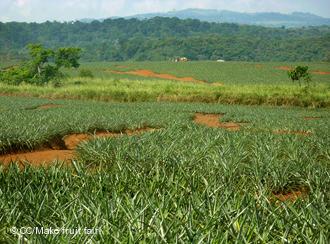
Costa Rica’s pineapple sector employs about 32,000 people directly and generates exports of about one billion dollars a year, which is the equivalent of 10 per cent of the country’s total exports, according to a report released today.
The study, “Economic, Social and Environmental Impact of Pineapple in Costa Rica”, conducted by the Central American Institute of Business Administration (INCAE) concluded that the pineapple sector’s economic and social importance in Costa Rica is significant.
“It generates employment in economically depressed areas and contributes to the generation of value through various productive chains, favoring the economic well-being of the country,” the report states.
The research shows that Costa Rica has 43 thousand hectares devoted to this crop, and that exports of pineapple and its derivatives totaled 1.08 billion dollars in 2015, making it the country’s main agricultural export.
According to the study, 98 percent of the pineapple produced is exported, mainly to the United States and Europe, and the sector is increasingly diversifying.
“This diversification aims to favor the reduction of production costs and increase the sector’s productivity, thanks to the potential effects of economies of scale and scope. This, in turn, would have a positive social impact, particularly regarding the participation of small producers and the generation of agricultural jobs in economically depressed geographical areas,” the report states.
According to estimates, the sector generates 130 thousand indirect jobs. In Costa Rica, a country of 4.7 million inhabitants, the total number of employed people amounts to just over two million.
The lowest-paid workers in the pineapple sectors have a salary of less than 450 dollars per month. According to the report, this is the second highest salary in the country for comparable activities.
The study indicates that, in general terms, the sector obtains favorable results in environmental and social practices, although some challenges prevail.
“Some producers have areas for improvement (especially those with less than 100 hectares) in issues related to working conditions, such as social security, occupational safety policies, and minimum wages,” the report said.
Regarding the environment, the study states that “the management of liquid wastes (sewage and post-harvest applications) requires additional efforts to improve management in smaller production systems.”
For many years, and also recently, pineapple expansion in Costa Rica has faced opposition from environmental sectors that have accused the industry of deforestation, contaminating water sources, and damaging the environment with agrochemicals.
A current controversy surrounding pineapple production revolves around a company that was granted permission to cultivate the fruit in an area of southern Costa Rica near protected wetlands and archaeological sites. Hundreds of protestors marched in the country’s capital to protest the permit.
As a result, the Ministry of Environment and Energy halted the company’s expansion, and ordered a review of the environmental permits that the Environmental Technical Secretariat gave to the Pindeco company, and of the archeological sites near the lands.
The company, a subsidiary of the transnational Del Monte, planned to plant pineapples on a 600-hectare farm in the southern Pacific Costa Rican area of Palmar Sur Osa, in the province of Puntarenas.



