


 SIGN UP FOR OUR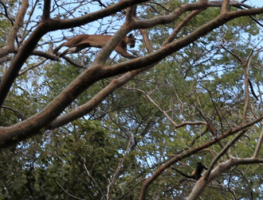
Puma hunting howler monkey in Guanacaste, Costa Rica. Photo by Professor Rob Pringle of Princeton University.
Professor Pringle’s steady hand and sharp eye produced a series of great photographs that show what Homo sapiens do not get to see everyday: A wildcat putting its climbing abilities to work to hunt arboreal species. This is how Professor Pringle described the situation:
it was a cat, specifically a puma […], and two seconds later it re-emerged, roughly 25 feet above the ground.
A short hop and a long leap later, the cat was within a meter or two:
But that was as close as it got. The monkey scooted out to the end of the branch and into an adjacent tree […]
Professor Pringle then mentions the scarcity of online resources that show other pumas hunting monkeys, and he also cites research that indicates monkeys are not part of puma’s usual diet. As agile as a puma might be, going after arboreal creatures such as howler monkeys seems like a very desperate hunt undoubtedly caused by hunger. Professor Pringle then makes this sharp conjecture:
Perhaps the puma was too shy to venture so far into human territory…
In the past, the Costa Rica Star has reported on research studies showing jaguars in Tortuguero, province of Limon, predating on sea turtles that massively arrive in the Caribbean beaches during nesting season. This was also seen as unusual, yet explained by the fact that human development (both for dwelling and farming) has pushed jaguars from the heart of the forest to its limits near the beach, where they can feast on sea turtles.
Felines in Costa Rica adapt to certain conditions in peculiar ways. Take, for example, Leopardus wiedii (margay or manigordos) that are far more arboreal than pumas, and which include the imitation of monkey calls as part of their repertoire. Here’s evolutionary biologist Jerry A. Coyne writing about the manigordos:
Margay babies are sometimes tamed by the locals. I once got to hold a (relatively) tame margay that belonged to a bar in Costa Rica; it let me pet it but then sank its teeth into my silver ring, leaving a sizeable dent.
Professor Coyne then cites a 2005 study of manigordos in South America that reported on their mimicking of monkey calls:
At 9:18 am, a margay attracted the attention of a tamarin sentinel (Gordo et al., 2005) by producing calls similar to those emitted by pied tamarin pups. The adult male sentinel climbed up and down the tree to investigate the calls coming from behind the liana tangles. It assumed a surveillance position and, using specific calls, warned the group about the foreign calls. At 9:22AM we observed movements in the vine and kept hearing the call imitations.
Professor Coyne concludes:
Learned mimicry (unless it’s an accidental vocalization that’s reinforced) presupposes a theory of feline mind that can reason thus: “If I make a sound like this, I can get a meal.” I suspect this isn’t just a case of vocal reinforcement, because cats don’t make non-mimetic noises when they’re hunting.
When monkeys are the species pushed out into different habitats by human development, felines will welcome their arrival with predation, as reported by a 2005 study published in the American Journal of Primatology:
We document the loss of all but the youngest member of a troop of six howler monkeys due to probable jaguar predation during a 7-month period in 1988. The formation of Guri Lake (Venezuela) resulted in forest fragmentation which forced monkeys into new and unfamiliar areas and altered the balance of predator and prey populations, and may thus have contributed indirectly to the success of the jaguar. The selection of defoliated (dead) trees for sleeping sites by the howler monkeys may have directly increased the risk of predation.



