


 SIGN UP FOR OUR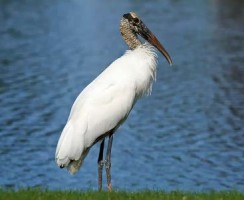
Source: Wikimedia Commons
A recent study indicates that a wading bird’s appetite for the hatchlings and freshly-laid eggs of sea turtles presents an interesting situation of interference competition in which nature conservation activists and local protectors of marine life in Costa Rica are choosing one wildlife species over another. The species in question are the beloved olive ridley sea turtle and the insufferable American wood stork.
The research paper is entitled Wood Storks (Mycteria americana) Prey on Eggs and Hatchlings of Olive Ridley Sea Turtles (Lepidochelys olivacea) at Ostional, Costa Rica. The authors are Joanna Burger and Michael Gochfeld of Rutgers University in New Jersey. Their observation took place at Playa Ostional in the province of Guanacaste, which is part of the pristine Ostional Wildlife Refuge and one of the most important nesting sites for the massive arrivals of olive ridley sea turtles.
According to their abstract, the situation at Playa Ostional is sort of a face-off between endangered species. The wood stork is an aquatic wading bird that is seemingly abundant in Central America, the Caribbean and the Florida Everglades. On the International Union for the Conservation of Nature (IUCN) Red List, which is maintained by an organization affiliated with the United Nations, the conservation status of the wood stork is of least concern (although the United States Fish and Wildlife Service classifies this species as endangered).
The Playa Ostional locals who jealously guard the massive arrival of female sea turtles to the beach are quite aware of wood storks and their penchant for eggs and hatchlings. As explained by Burger and Gochfeld:
Usually, one to three Wood Storks fed at a turtle nest; an average of 87% of the Wood Storks that were within 5 m of a turtle nest obtained eggs or hatchlings.
Although it may appear that these birds are feasting unrestrainedly at Playa Ostional, the fact is that:
Wood Storks had little effect on success of olive ridley sea turtles at Ostional because of the very large number of nesting female turtles, the small population of Wood Storks, and that most turtle hatchlings emerge at night when Wood Storks did not forage. Wood Storks were scared off by people during the peak daylight hatching period […]
It should be noted that wood storks are not the only predators that nesting sea turtles face. Locals also keep away vultures, dogs and human poachers, although it should be noted that locals also take eggs that are later peddled in bars across Costa Rica. This controlled taking is monitored by conservation activists and officials, and it can only take place as long as the beach and the turtles are protected by the community.
So, Which Species Matters Most?
The interference competition conundrum has been previously explored by the Costa Rica Star:
Conservationists in Costa Rica are in a quandary over one endangered species’ newfound appetite for another threatened species. According to a recent study, researchers have observed a perplex situation unfolding in Tortuguero National Park in the province of Limon: jaguars voraciously feeding on marine turtles arriving during nesting season.
Just like in the situation at Playa Ostional there is an anthropogenic effect at play. The jaguars of Tortuguero and the wood storks at Ostional are affected by the use of sea turtles as a flagship species of Costa Rica for the purpose of marketing biodiversity conservation and attracting more eco-tourism dollars. There seems to be a greater affinity for sharks, sea turtles and other marine species than for aquatic birds -unless you are an avid bird watcher or member of the Audubon Society. In the end, Homo sapiens always finds a way to benefit from such dilemmas.



