


 SIGN UP FOR OUR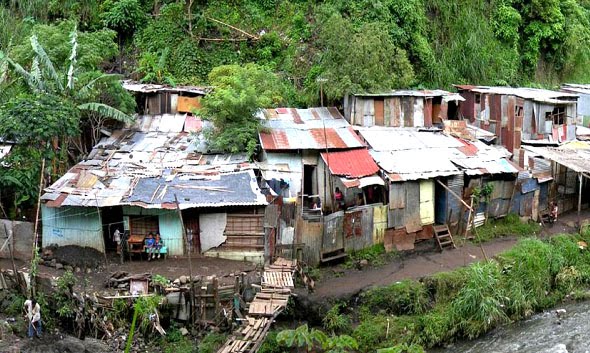
La Carpio, an impoverished neighborhood in the San Jose metro area. (ICR-CRS Archive)
Editor’s note: Special reports from The Costa Rica Star contain in-depth analysis by our staff of the facts, data and trends affecting our country that you won’t find anywhere else. Stay tuned to The Costa Rica Star for part 2 of this story later this week.
By Timothy Williams, The Costa Rica Star
Despite ranking amongst Latin America’s highest spenders on social programs, Costa Rica also ranks amongst the countries with the lowest reduction in its poverty rate in recent years, according to a report this month by the United Nations (UN) Economic Commission for Latin America and the Caribbean (ECLAC).
According to the report, Costa Rica spends about US $2,000 per year for every man, woman, and child living in the country, a figure that ranks amongst the highest in Latin America and places the country amongst the region’s biggest social spenders such as Argentina, Brazil, Chile, Panama, Uruguay and Cuba, according to the report, which is based on data from 2010 to 2014, the latest available.
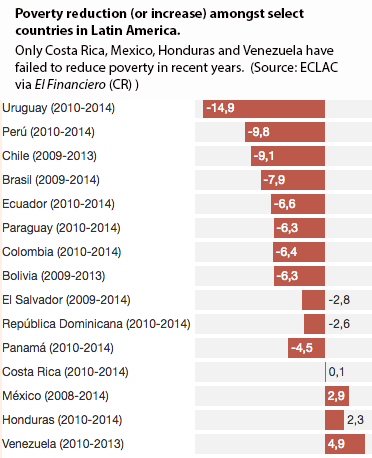
However, Costa Rica, with more than 20 social spending programs, is amongst only four countries in Latin America that is failing to reduce its poverty rate. The other three are Mexico, Honduras, and Venezuela.
Even countries that spend far less on social programs managed to reduce the number of those living in poverty and extreme poverty by significant amounts in recent years.
Take for example, Nicaragua, a country that spends an average of just $300 per capita annually on social programs – one of the very lowest figures in Latin America – but which has managed to reduce its poverty rate by 15 percent over the last nine years, according to official data.
Meanwhile, Costa Rica’s poverty rate – which continues to hover at nearly 25 percent of the population – has remained almost unchanged for some 20 years, despite the country consistently ranking amongst Latin America’s biggest spenders on social programs for the same two decades: decades in which the country also witnessed significant economic growth.
 Costa Rica’s inability to decrease poverty is curious, in a country that has amongst the highest household incomes in Latin America. Nominally, average household income in 2014 was just over US $1,800 per month, according to the National Statistics and Census Institute (INEC), which also said in the same report that 318,810 households lived in poverty and another 98,810 in extreme poverty. As of 2015, more than 1.1 million people – about a quarter of Costa Rica’s population – lived in poverty.
The answer seems to be a growing disparity between the incomes of the less educated, rural portions of the population and the more educated, urban population, concentrated in the San Jose metro area.
According to data from the 2014 census, some 19 percent of urban households lived in poverty and another 5.2 percent in extreme poverty. But in rural areas, those numbers increase to 30.3 percent and 10.6 percent, respectively.
Costa Rica’s poor are getting poorer
Not only is Costa Rica’s poverty rate frustratingly stagnant, those living in poverty are earning less than ever before.
Between 2010 and 2015, the poorest 20 percent of households saw their inflation-adjusted incomes fall by 17 percent.
On average, the poorest 20 percent of households saw their household income reduced from ¢234,819 (in inflation adjusted, or ‘constant’ colones) to ¢194,541 in 2015 (about US $364).
The poorest 20 percent of the population are also seeing their unemployment rates skyrocket. The unemployment rate of the poorest 20 percent of households increased by 29 percent between 2010 and 2015, according to data from INEC.
An uneducated workforce
Despite the country’s efforts in recent years to tout a “highly educated workforce” in its attempts to attract foreign investment, data suggests otherwise.
According to INEC data from 2013, 56 percent of the country’s workforce had not graduated high school, and 71 percent had never received any form of additional education past high school.
A worker in Costa Rica who has completed high school will earn, on average, 23.5 percent more than a worker who has not for doing the same job; effectively meaning, according to some analysts, if all workers in the country had a high school diploma, the country’s poverty rate would be cut in half.
Still, there is a lot more to the story than just education, which we will examine in part 2 of this series.
Editor’s note: Stay tuned to The Costa Rica Star for part 2 of this story later this week.



