


 SIGN UP FOR OUR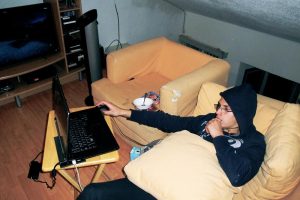
Wikimedia Commons
Bolivian writer Oswaldo Calatayud, the winner of his country’s 17th National Novel Prize for his work “La Guerra del Papel” (The Paper War), says that the “ultra-tech” world has reinforced human loneliness.
In an interview with EFE, the author explained that nowadays “there is little contact between people because technology intercedes in everything. Being on the cellphone all the time, with the machines, increases loneliness.”
Calatayud explores that issue in his novel, his first published work, which takes place an undetermined number of years in the future and in which the main character is “an athlete who is deformed, who is becoming transformed by a disease.”
The athlete, who cannot write for himself, sends messages to an elite female athlete “who is like an obsession he has,” but “the letters just go out … there’s never a response,” says Calatayud about his novel, which is being published by Editorial 3600.
Besides letters, he said his work is a “collage” including monologues, fragments in Braille and newspaper clippings invented “to put into context that future” where the tension is that everything is done in letters.
He also said that “people spend more time writing or reading things on a social network than picking up a book. The idea that we have more books available in PDF or in virtual spaces is a lie, they’re like mirrors that simply bounce you back to nothing. You’re reading everything and nothing at the same time.”
“I myself have really gotten into (passing my work around among friends) upon seeing that I had no chance to publish anywhere,” he said, adding that he currently does assorted work on the margin of literature, including graphic design, photography, editing, among other things, and he decided to invest the $15,000 that came with the literary prize in building his house.
The award was announced in late June and is sponsored by the Bolivian government, Spain’s AECID international development cooperation agency, Spain’s BBVA bank and Bolivia‘s Entel. EFE
La Paz, Jul 10 (EFE)



