


 SIGN UP FOR OUR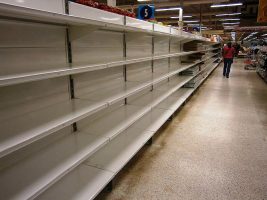
Wikimedia Commons
“You can’t get it more cheaply” calls a Caracas woman selling flour at the open-air market in Petare, the largest shantytown in Latin America, where hundreds of vendors offer basic products that are generally scarce here at prices often more than 20 times higher than those fixed by the government.
Stringent price controls have prevailed in Venezuela since 2003 but, nevertheless, this kind of “black market” operates daily in the eastern portion of the capital.
The street vendors set up along several kilometers of sidewalks where they display the most sought-after food products, toiletries and personal hygiene items, while they try to haggle with each potential buyer to maximize their profits.
“Take the rice, 2,400 bolivares per kilo,” chants a young man moving through the crowd, one of many itinerant hawkers who find that they can make more money moving about the marketplace searching for customers.
Stamped on the packet of rice that he holds is the “fair price” of 120 bolivares per kilogram established by the Venezuelan government, just one-twentieth of the price he is publicly calling a “bargain.”
The official Venezuelan exchange rate is 9.95 bolivares per U.S. dollar.
In fact, all the basic items sold to the public have prices preset by the Department for the Defense of Socioeconomic Rights, or Sundde, although these are routinely ignored by both sellers and buyers at the Petare market and – for instance – this week a bar of soap with the fixed price of 10 bolivares is going for 1,000.
The “bachaqueros,” as these resellers or scalpers are called in Venezuela, buy most of the basic products at government-established prices from formal commercial establishments, but then they turn around and sell the deodorant, ground coffee, sugar, or whatever at Petare or elsewhere for at least a 2,000 percent markup.
Venezuelan economist Luis Vicente explained to EFE that the drop in local production and in imports by this oil-producing nation, combined with government controls over the sale of basic products, has led to scarcities and allowed black market prices to skyrocket.
“Last year, the markup in regulated goods was from 10 to 15 times. In the first quarter of this year, they they up to 80 times, but that has been changing,” he said, due to the government’s allowing some prices to fluctuate freely, going on to estimate that the current black market markup varies between 50 and 60 times.
Meanwhile, Sundde is tasked with sanctioning people who fail to comply with the established prices, and fines have been levied on all sorts of businesses and – more recently – popular markets to “fight” the “bachaqueros.”
In mid-July, Sundde officials turned up at the Petare market, seized more than a ton of regulated food products and arrested 29 people for reselling those items, the government reported.
Last week, the president ordered the military to raid municipal markets to “clean out those dens” where, he said, criminal mafias operate and engage in crimes such as drug trafficking, prostitution and people trafficking.
Meanwhile, Venezuelans are suffering from the world’s highest inflation rate and groups of friends, teenagers, housewives and street vendors each day flock to Petare to try and resell assorted products and make a profit. EFE
Caracas, Aug 18 (EFE)



