


 SIGN UP FOR OUR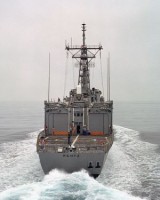
The view from abaft: USS Rentz. Source: Wikimedia Commons.
A legislative kerfuffle may result in the indefinite suspension of a legislative permit that allows the United States Navy and Coast Guard to patrol the waters off Costa Rica.
According to a news report filed by Janier Pichardo of daily tabloid Diario Extra, lawmakers from the majority National Liberation Party (Spanish initials: PLN) and Frente Amplio (Broad Front) have been embroiled in a disagreement that is holding up several legislative projects, including the permission that the U.S. military requires to take part in the Joint Patrol Agreement, which focuses on drug trafficking interdiction off the Caribbean and Pacific coasts of Costa Rica.
Ghost Ships
PLN legislator Rolando Gonzalez explained that his party will not issue a vote on the Joint Patrol Agreement because of what he considers to be a major oversight. Legislator Gonzalez explains that his staff reviewed the current registry listing the U.S. Navy and Coast Guard ships assigned to the Joint Patrol Agreement, which apparently includes four vessels that are no longer in action. Those four ships, the legislator explains, have been withdrawn from active duty and donated to other nations, where they are in service under different names.
Moreover, Legislator Gonzalez said that to vote on the Joint Patrol Agreement at this time would be akin to issuing a phantom vote due to the four aforementioned ghost ships.
As previously reported by The Costa Rica Star, certain U.S. Navy and Coast Guard ships are allowed to participate in the Joint Patrol Agreement only if the Legislative Assembly votes to allow foreign military forces to enter the country.
The Joint Patrol Agreement is hardly the only legislative project affected by the current political discord at the Assembly, which stems from what some politicians consider to be nitpicking by the PLN. There are about 80 legislative proposals tied up by the PLN, which claims that they are tired of deficient laws being passed in Costa Rica. The PLN may have a point in this regard: the majority of the judicial cases handled by the Constitutional Chamber of Costa Rica are related to enacted laws that end up being unconstitutional.
The majority PLN is currently the political faction in opposition to the administration of President Luis Guillermo Solis.



