


 SIGN UP FOR OUR
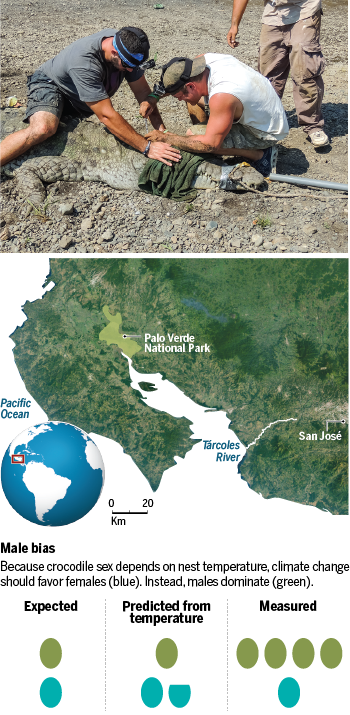
Scientists in Tennessee identified something curious in Costa Rica’s crocodiles that has sent them on a global journey to understand the potential role of a synthetic hormone in changing the reptiles’ sex.
A recent report in Science Magazine discussed the muddy crocodile sex-tracking forays of Chris Murray, physiological ecologist at Tennessee Technological University in Cookeville, and his research team in Costa Rica’s Palo Verde National Park in Costa Rica’s northern Pacific wetlands near the Tempisque River.
After three years of data collection, and nearly 500 crocodiles identified, Murray was stunned to find males outnumbered females nearly four to one. Even more surprising was the presence of the synthetic steroid 17α-methyltestosterone (known as MT) in the crocs, a chemical that makes its way into the environment only by way of human activity.
The steroid, Murray tentatively has put forward, might be responsible for such a skewed sex ratio. But how did it get into the crocodiles’ bodies?
Scientists honed in on a potential source of MT: nearby tilapia farms, which lace tilapia food with the steroid in order to produce more males – which grow larger than females. Tilapia production has increased dramatically in Costa Rica and other parts of Latin America in recent years.
While more male crocodiles is not necessarily a problem, what could definitely be a problem is if the steroid exposure has affected their reproductive capacity, said Murray, who also pondered the implications of the hormone in the larger marine and riparian ecosystem which is shared by many other species.
Murray also wondered whether exposure to MT – which is only available for human use through medical prescription to treat certain hormone disorders, and which is abused by some bodybuilders to bulk up -could cause increased aggression in crocodiles.
In a laboratory setting, Murray found the steroid to have a masculinizing effect on alligator hatchlings, which he incubated at a temperature which should have produced females and exposed to MT, said the report in Science Magazine.
When Murray and his team began to consult with colleagues and investigate whether nearby tilapia farms could be a source of MT in Palo Verde national park, they came up with several theories.
One idea is that some tilapia could escape from the farms and get eaten by crocs, which then store MT in their fat, and, when females produce eggs, they pass the hormone on to their offspring.
Another is that tilapia farms could be mishandling the hormone, or recipients containing residues, thus contaminating the river water. Also residues from tilapia feed which is laced with the hormone could be getting washed into the river.
But crocodiles at the mouth of the Tarcoles River, 100 kms south of Palo Verde and another favored croc hangout, also had traces of MT, making scientists wonder if they need to investigate potential other sources of the steroid. Because the Tarcoles passes through urban areas, it is possible that residues from bodybuilders using the steroid could be entering the river.
But the link between MT and a skewed sex ratio is not completely convincing to some scientists, like environmental toxicologist Gerald LeBlanc at North Carolina State University who said that with female and male crocodiles exhibiting the same levels, MT might not be the culprit, continued the report in Science.
In the meantime, Murray is continuing his tireless quest to better understand these fearsome reptiles, and has studies underway to check for altered sex ratios and MT contamination in Indonesia’s and South Africa’s crocodiles, as well as in other parts of Costa Rica.



