


 SIGN UP FOR OUR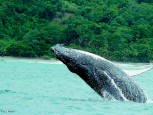
Humpback whale breaching in Costa Rica
The Southern Pacific region of Costa Rica is known as one of the country’s major magnets of ecotourism revenue. One of the big draws to the coastal region of the Osa Peninsula is the Parque Nacional Marino Ballena (Ballena Pelagic National Park), a unique spot on Earth that is known as an “aquatic labor and delivery chamber” for many cetaceans, including humpback whales. As expected, a fleet of local whale watching tour operators make their living in the National Park; regrettably, their presence and operations could be interrupting the delicate birthing of marine life.
According to online news publication El Pais, the 300 marine mammals that arrive each year at the Ballena Pelagic National Park in Costa Rica do so instinctively; marine biologists believe that Ballena Bay is blessed with the right mixture of elements to attract expectant whales. These elements include the ocean floor architecture, the chemical make up of sea water, the abundance of plankton, the ocean currents, and the climate.
Whales swim hundreds of miles to arrive in Costa Rica’s Southern Pacific coastal region; almost like following a siren song, these gentle giants arrive at the Ballena Pelagic National Park in a trance-like state. This is similar to the biological state that many sharks enter when they swim near Isla del Coco (Cocos Island) in search of healing; which is why shark fin poachers surreptitiously roam the waters near the island: They know that sharks under a hypnoid state are easy catch.
Not Enough Resources to Protect Whales
The National Coast Guard Service of Costa Rica and the National System of Conservation Areas (Spanish acronym; SINAC) patrol Ballena Bay to keep poachers, unscrupulous fishermen and disruptive drug smugglers from interfering with the arrival of whales, an event that also attracts dolphins ,stingrays and hammerhead sharks. Conservation officials should also monitor the numerous whale watching tour operators, but resources are stretched thin.
Zdenka Pisculich is the director of Costa Rica Por Siempre (Costa Rica Forever), a nature conservation group that is concerned that whale watching activity in Ballena Bay may not be following Executive Decree 34,327, which issues directives on this type of ecotourism to avoid disrupting the unique birthing process of whales in Costa Rica. Some tour operators are not keeping proper distance between whales and their boats, and others are using inboard and outboard engines that are not equipped with noise dampeners to avoid acoustic disruption of entranced whales.
Ms. Pisculich’s group is working with SINAC to augment patrols, perform biological counts and place more markers that will help whale watching touts to comply with Executive Decree 34,327. To this end, Costa Rica Forever is donating $80,000 to SINAC’s operations, and it expects to donate $240,000 in the next two years to augment protection of marine mammals elsewhere in Costa Rica.



